The Ultimate Guide to Handmade Leather Belts: Quality, Craftsmanship, and Style
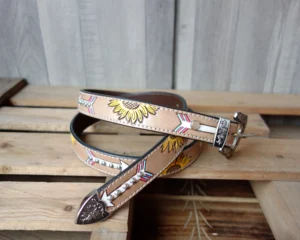
Fast fashion often dominates the retail market, pushing cheap accessories built to last only a few months. In contrast, authentic handmade leather belts stand as a testament to durability, individual craftsmanship, and functional design. Investing in premium handmade leather belts ensures you receive an accessory that matures gracefully with age, developing a rich patina that reflects daily wear and timeless utility.
If you are looking to upgrade your wardrobe with a durable staple, exploring our collection of [Link: Men’s Handmade Leather Belts Collection] is the best place to start.
1. The Anatomy of Real Leather: Understanding Grades and Tanning
Not all leather belts offer equal quality. The overall quality, flexibility, and lifespan of leather belts depend entirely on the raw hide grade selected and the tanning process applied by the artisan.
Leather Grades Explained
Full-Grain Leather (The Gold Standard): Cut directly from the top layer of the hide right below the hair. High-end leather belts made from full-grain hide retain natural grain markings and the tightest fiber density. Because the surface is un-sanded and un-buffed, [Link: Full-Grain Leather Belts] offer maximum breathability and tensile strength, developing an unmatched vintage patina over time.
Top-Grain Leather: The second-highest grade used in mid-tier leather belts. The surface layer is lightly sanded to buff away blemishes, followed by a protective finish coating. While flexible and uniform, top-grain leather belts lack the long-term structural integrity and rich aging properties of full-grain hides.
Genuine Leather (Split Leather): Despite the misleading name, commercial leather belts labeled as “genuine leather” use the bottom split layers of the hide. Coated with synthetic polyurethane and embossed with fake grain patterns, these leather belts stretch, peel, and break under regular tension.
Bonded Leather: Constructed from shredded leather scraps glued together using polyurethane bonding agents. Low-cost leather belts made from bonded material deteriorate rapidly and are never used in authentic artisanal leathercraft.
Vegetable Tanning vs. Chrome Tanning
| Feature | Vegetable Tanned Leather Belts | Chrome Tanned Leather Belts |
| Tanning Agent | Natural tree barks, roots, and plant tannins | Chromium salts and synthetic chemicals |
| Process Duration | 4 to 8 weeks of slow soaking | 1 to 2 days |
| Feel & Structure | Firm and rigid initially; molds perfectly to your body | Soft and pliable immediately |
| Environmental Impact | Biodegradable and eco-friendly | Heavy chemical waste footprint |
| Patina Development | Rich, darkening patina with age | Minimal to none |
| Best Used For | Heavy-duty everyday leather belts, holsters, saddlery | Soft jackets, car upholstery, fast fashion |
Handcrafted accessories rely heavily on [Link: Vegetable Tanned Leather Goods] because natural tannins provide the exact thickness and rigidity required for heavy-duty leather belts to hold trousers securely without sagging.
2. Step-by-Step: How Handmade Leather Belts Are Crafted
The production of artisanal leather belts differs fundamentally from automated factory assembly lines. Every individual piece among handcrafted leather belts is cut, beveled, edged, and finished by hand.
+-------------------------------------------------------------+
|                     1. Hide Selection                       |
|           (Heavy vegetable-tanned steer hide)               |
+------------------------------+------------------------------+
                               |
                               v
+-------------------------------------------------------------+
|                     2. Strap Cutting                        |
|       (Precision-cut to width: 1.25", 1.5", or 1.75")       |
+------------------------------+------------------------------+
                               |
                               v
+-------------------------------------------------------------+
|                    3. Edge Beveling                         |
|         (Shaving sharp corners for smooth comfort)          |
+------------------------------+------------------------------+
                               |
                               v
+-------------------------------------------------------------+
|                   4. Punching & Slotting                    |
|      (Oval sizing holes + elongated buckle-tongue slot)     |
+------------------------------+------------------------------+
                               |
                               v
+-------------------------------------------------------------+
|             5. Saddle Stitching / Hardware Assembly         |
|      (Hand-stitched waxed thread or solid Chicago screws)   |
+------------------------------+------------------------------+
                               |
                               v
+-------------------------------------------------------------+
|               6. Edge Burnishing & Finishing                |
|      (Beeswax friction polish for glass-smooth edge)        |
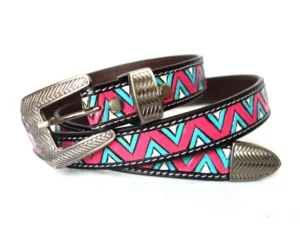
+-------------------------------------------------------------+
Step 1: Hide Selection and Strap Cutting
An artisan starts with an unblemished piece of heavy vegetable-tanned steer hide (typically 9–10 oz thickness). Using a draw gauge strap cutter, strips are sliced along the densest part of the back to eliminate stretch.
Step 2: Edge Beveling
Raw cut edges have sharp corners. Craftsmen use an edge beveler tool to pare down the edges, creating a rounded, comfortable contour.
Step 3: Punching Holes and Buckle Slots
Artisans use specialized punches for precision:
English Point Punches to contour the belt tip.
Oblong Bag Punches for the buckle tongue channel.
Oval Hole Punches for sizing holes. Oval holes allow the buckle tongue to lie flat without pinching or stretching the leather.
Step 4: Traditional Saddle Stitching
When perimeter stitching is applied, artisans use traditional two-needle saddle stitching with waxed thread. If one stitch breaks, the surrounding stitches remain locked in place—unlike machine lockstitches that unravel completely.
Step 5: Hardware Assembly
Buckles are secured using either solid metal rivets or threaded Chicago screws, allowing you to swap hardware effortlessly.
Step 6: Edge Burnishing & Sealing
The mark of high craftsmanship is a smooth, glass-like edge. The edges are rubbed with natural compounds like Tokonole or gum tragacanth and friction-burnished with wooden slickers before being sealed with pure beeswax.
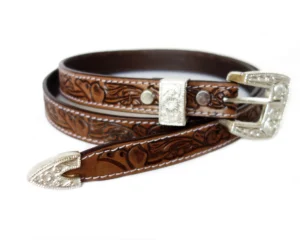
3. Hardware Matters: Choosing Solid Brass & Stainless Steel
A durable belt requires hardware of equal strength. Cheap retail belts rely on zinc alloy or nickel-plated pot metal that easily snaps.
Solid Brass: The industry standard for heritage accessories. Brass will never rust, withstands severe tension, and develops an antiqued patina matching full-grain leather. Check out our [Link: Solid Brass Buckle Belts Collection].
Stainless Steel: Rust-proof and sweat-resistant, making it ideal for heavy-duty workwear and minimalist casual styles.
Interchangeable Chicago Screws: Threaded fasteners allow you to switch buckles in seconds without damaging the leather strap.
4. Belt Width, Thickness, and Style Guide
Selecting the right handmade belt requires matching dimensions to your trousers and use case.
| Style / Use Case | Recommended Width | Leather Thickness (Oz / mm) | Buckle Type |
| Dress & Formal Suits | 1.25 inches (32 mm) | 7–8 oz (2.8–3.2 mm) | Sleek polished brass or stainless steel |
| Everyday Casual (Jeans/Chinos) | 1.50 inches (38 mm) | 9–10 oz (3.6–4.0 mm) | Antiqued roller buckle |
| Heavy-Duty Workwear & Utility | 1.50 to 1.75 inches | 12–14 oz (4.8–5.5 mm) | Heavy-duty double prong or utility roller |
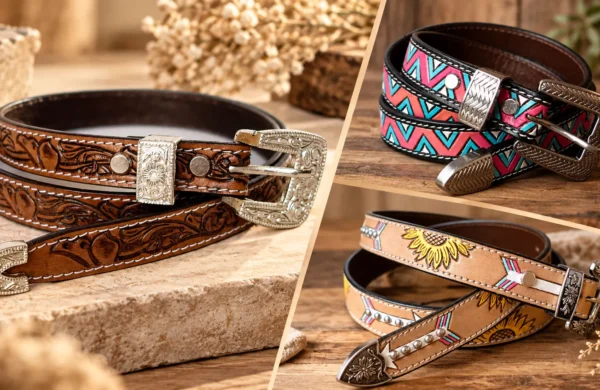
| Western & Casual Heritage | 1.50 to 1.75 inches | 10–12 oz (4.0–4.8 mm) | Engraved floral or custom silver buckle |
Looking for a daily option? Browse our [Link: Everyday Casual Leather Belts (1.5 Inch)].
5. How to Find Your True Belt Size (The Standard Sizing Rule)
One of the most common mistakes is ordering the same size as your pants.
The Standard Sizing Rule: Always order a belt 2 inches larger than your actual pant waist size.
If you wear size 34 jeans, your handmade belt size is 36.
[Belt Buckle Fold] ======================================== (Center Hole) ==== (End Tip)
                   |<-------------- 36 Inches ------------->|
                   |       (Matches 34" Pant Size + 2")      |
Why the +2 Rule Works
Pant sizing runs small and doesn’t account for tucked shirts or material thickness.
A proper belt fastens in the middle hole (the 3rd of 5 holes), giving you adjustment room in both directions.
Measuring an Old Belt
Lay your current belt flat on a table.
Measure from the inside edge of the buckle frame to the hole you currently use.
That length in inches is your true belt size.
Need more sizing details? Read our full [Link: Complete Leather Belt Sizing Guide].
6. Maintenance and Care: Making Leather Last a Lifetime
Vegetable-tanned leather is resilient, but simple maintenance keeps the fibers flexible:
Keep It Clean: Wipe away sweat and dust with a damp microfiber cloth. Never soak leather in water.
Condition Periodically: Apply a quality conditioner or neatsfoot oil once or twice a year to keep fibers hydrated. Learn more in our [Link: Leather Care and Conditioning Guide].
Air Dry Naturally: If soaked in rain, let it air dry away from heaters and direct sunlight to prevent leather shrinkage and cracking.
Hang Properly: Hang the belt vertically by its buckle or loosely coil it. Avoid tight rolling or bending against the grain.
Final Thoughts
A handmade full-grain leather belt is more than just a functional accessory—it is an investment in sustainable craftsmanship that looks better every year.
Ready to upgrade your everyday carry? Explore our handcrafted collection of [Link: Premium Handmade Full-Grain Leather Belts] and find the perfect fit for your style.