Custom Leather Belts USA | The Ultimate Craft Guide

Custom Personalized Leather Belts Made in the USA: Craftsmanship, Quality, and Style

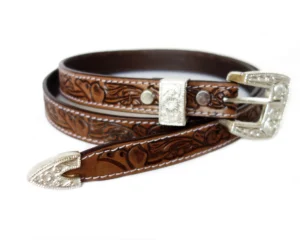
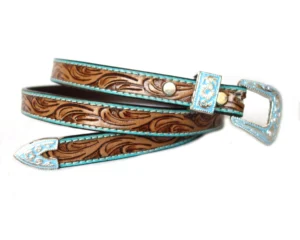
Hand-tooled custom leather belt USA with western floral carving and turquoise accents.
Handcrafted floral-tooled leather belt with premium western stitching and turquoise inlay.


Investing in custom leather belts USA is an investment in durability, everyday utility, and individual identity. In a modern market flooded with fast fashion, mass manufacturing, and synthetic imitations, the demand for authentic, American-made leather goods continues to rise. A bespoke belt made by domestic craftsmen delivers an heirloom-quality accessory designed to age gracefully over decades of wear.

1. The Heritage of Custom Personalized Leather Belts in the USA

American leathercraft carries a rich tradition rooted in saddlery, utilitarian work gear, and equestrian trades. Historically, belts and harnesses were built to withstand harsh outdoor labor and unpredictable weather.

Why buying American-made leather goods matters:

  • Ethical Production and Fair Labor: US-based workshops operate under strict labor regulations, providing fair wages and safe working environments.

  • Traceable Tannery Sourcing: Top domestic makers source raw hides directly from historic American tanneries such as  Leather Company and Wickett & Craig.

  • Uncompromising Standards: American artisans use solid brass, stainless steel, and un-split hides rather than cheap synthetic substitutes. Learn more about our manufacturing philosophy on our About Us Page.

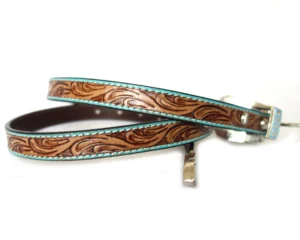
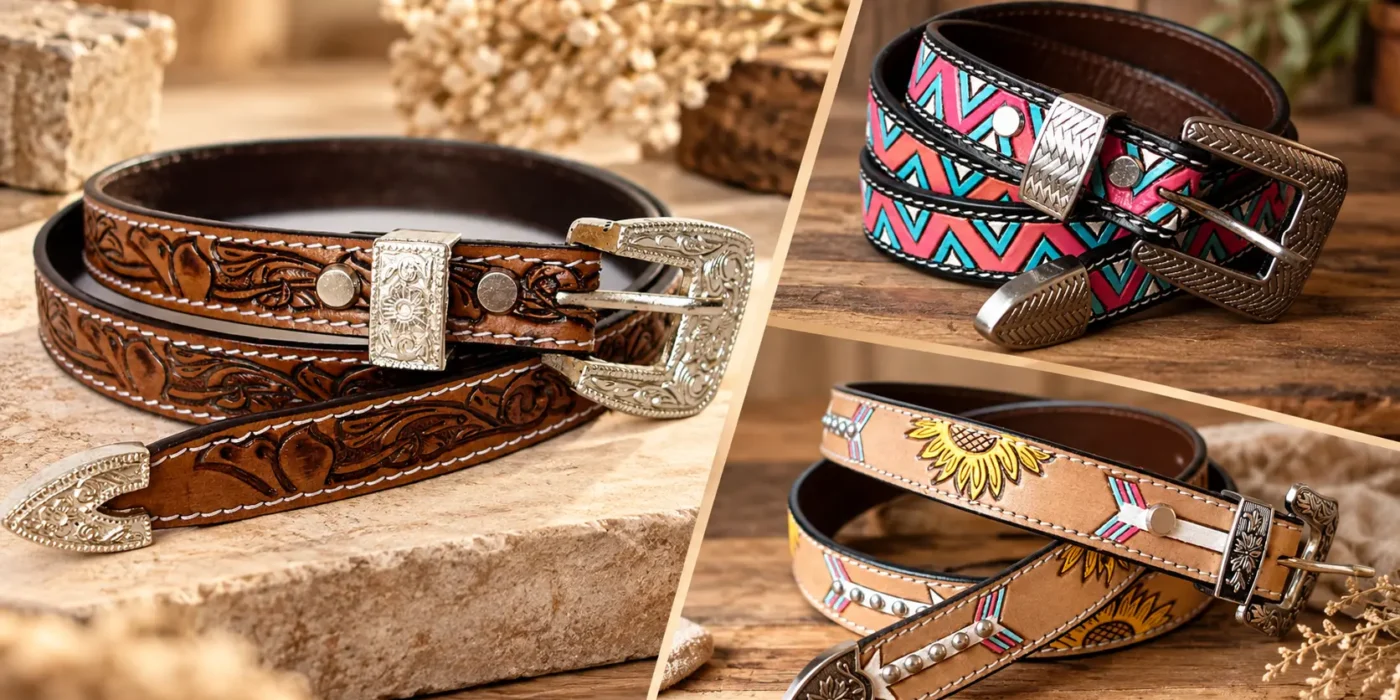
Custom leather belts USA with western floral tooling, turquoise trim, and matching silver engraved buckle set.
Hand-tooled western leather belt featuring intricate floral carving, turquoise edges, and engraved buckle hardware.

2. Leather Grades: Choosing Quality for Custom Personalized Leather Belts

Metric / Feature Full-Grain Leather Top-Grain Leather Genuine / Split Leather Bonded Leather
Tensile Strength Exceptional High Moderate / Low Very Low
Lifespan 10 to 30+ Years 5 to 10 Years 1 to 2 Years 6 to 12 Months
Patina Formation Deep, rich sheen Minimal None (Peels) None (Flakes)
Custom Stamping Crisp & permanent Moderate Shallow / Weak Unsuitable
Edge Treatment Hand-burnishable Edge paint required Synthetic seal Edge tape
  • Full-Grain Leather: The gold standard. Retains the entire natural grain layer, delivering maximum tensile strength, breathability, and rich patina development.

  • Top-Grain Leather: Sanded lightly to remove surface blemishes. Thinner and more uniform, but lacks long-term fiber strength.

  • Genuine/Split Leather: Lower fibrous layers coated in polyurethane (PU). Prone to stretching and cracking.

  • Bonded Leather: Shredded scrap fibers glued with plastic adhesives. Common in fast-fashion items.

3. Vegetable Tanning vs. Chrome Tanning

The tanning method determines how custom personalized leather belts age, feel, and retain custom impressions.

  • Vegetable Tanning (Veg-Tan): An organic, 6-to-12-week process using natural tannins from tree bark. It yields dense, firm hides that accept sharp monograms, edge burnishing, and deep tooling. It is the premier choice for bespoke leather goods.

  • Chrome Tanning: A chemical-based method completed in 24 to 48 hours using chromium salts. It yields supple, water-resistant leather ideal for jackets, but it does not hold stamped impressions as sharply as vegetable-tanned hides.

4. Personalization Options for Custom Leather Belts

Personalizing a leather belt allows you to configure exact aesthetics, sizing, and daily functionality.

  • Blind Debossing & Foil Stamping: Heat-pressed dies leave deep, permanent impressions without ink, or apply gold/silver foils for high-visibility monogramming.

  • Custom Tooling: Hand-carved Sheridan floral patterns, geometric basket-weaves, and stitched border grooves.

  • Thickness & Weight (Ounces):

    • 8–9 oz (3.2–3.6 mm): Lightweight formal dress belts.

    • 10–12 oz (4.0–4.8 mm): Standard everyday casual wear.

    • 14–16 oz (5.6–6.4 mm): Dual-layer heavy-duty gun and work belts. Explore available weights in our Custom Belt Collection.

5. Hardware Selection: Built for Longevity

A custom strap requires rugged hardware that will not snap under tension.

  • Solid Brass: Heavy, rust-proof, and oxidizes naturally to complement aging leather.

  • Stainless Steel: Corrosion-resistant and hypoallergenic, ideal for humid environments.

  • Attachment Methods: Choose removable Chicago screws for easy buckle swaps, heavy-duty snaps, or permanent saddle stitching for a sleek profile.

6. How to Measure Your True Belt Size

Pant sizes use vanity sizing and do not reflect accurate belt length. Always measure an existing belt for an exact fit.


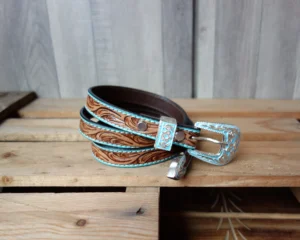
Handcrafted custom leather belts USA made with carved western pattern, turquoise border, and silver buckle on rustic wood.
Hand-tooled western leather belt with turquoise painted accents and engraved hardware displayed on a rustic wooden backdrop.
[Buckle Fold / Pin]==============================[Current Hole]----[Tip]
|<----------------- TRUE BELT SIZE ------------->|
                   (e.g., 36 inches)
  1. Lay an existing, well-fitting belt flat on a hard surface.

  2. Measure from the inside edge of the buckle (where the prong rests) to the hole you use most often.

  3. Do not measure to the end of the belt tip.

  4. Alternative method: Add 2 inches to your standard off-the-rack pant waist size (e.g., a size 34 pant generally takes a size 36 belt).

7. Caring for Your Custom Leather Belt

Keep full-grain leather hydrated and supple with a straightforward care routine:

  • Clean: Wipe away dirt using a damp microfiber cloth with distilled water or mild glycerin saddle soap.

  • Condition: Apply pure neatsfoot oil, beeswax balm, or Bick 4 once or twice a year to replenish natural oils.

  • Storage: Hang vertically from the buckle on a rack or coil loosely in a dry, ventilated area.


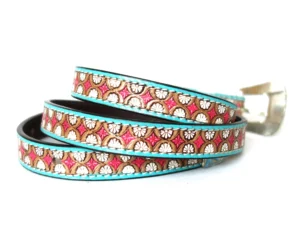
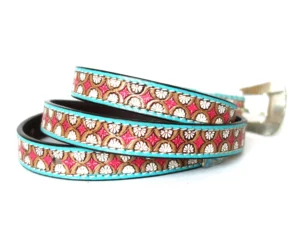
Custom leather belts USA with stamped geometric daisy pattern, pink and white hand-painted inlay, and turquoise stitched trim.
Hand-stamped custom leather belt featuring vivid pink and white floral motifs paired with bright turquoise edge detailing.


Handmade Leather Belts

The Ultimate Guide to Handmade Leather Belts: Quality, Craftsmanship, and Style

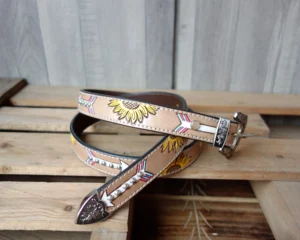
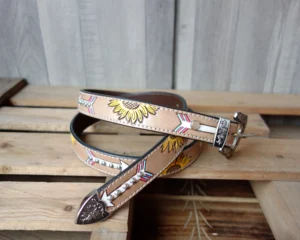
Hand-painted sunflower handmade leather belts with western arrow tooling and silver buckle.
Handcrafted western tan leather belt styled with painted sunflowers, studded arrow accents, and vintage metal hardware.


Fast fashion often dominates the retail market, pushing cheap accessories built to last only a few months. In contrast, authentic handmade leather belts stand as a testament to durability, individual craftsmanship, and functional design. Investing in premium handmade leather belts ensures you receive an accessory that matures gracefully with age, developing a rich patina that reflects daily wear and timeless utility.

If you are looking to upgrade your wardrobe with a durable staple, exploring our collection of [Link: Men’s Handmade Leather Belts Collection] is the best place to start.

1. The Anatomy of Real Leather: Understanding Grades and Tanning

Not all leather belts offer equal quality. The overall quality, flexibility, and lifespan of leather belts depend entirely on the raw hide grade selected and the tanning process applied by the artisan.

Leather Grades Explained

  • Full-Grain Leather (The Gold Standard): Cut directly from the top layer of the hide right below the hair. High-end leather belts made from full-grain hide retain natural grain markings and the tightest fiber density. Because the surface is un-sanded and un-buffed, [Link: Full-Grain Leather Belts] offer maximum breathability and tensile strength, developing an unmatched vintage patina over time.

  • Top-Grain Leather: The second-highest grade used in mid-tier leather belts. The surface layer is lightly sanded to buff away blemishes, followed by a protective finish coating. While flexible and uniform, top-grain leather belts lack the long-term structural integrity and rich aging properties of full-grain hides.

  • Genuine Leather (Split Leather): Despite the misleading name, commercial leather belts labeled as “genuine leather” use the bottom split layers of the hide. Coated with synthetic polyurethane and embossed with fake grain patterns, these leather belts stretch, peel, and break under regular tension.

  • Bonded Leather: Constructed from shredded leather scraps glued together using polyurethane bonding agents. Low-cost leather belts made from bonded material deteriorate rapidly and are never used in authentic artisanal leathercraft.

Vegetable Tanning vs. Chrome Tanning

Feature Vegetable Tanned Leather Belts Chrome Tanned Leather Belts
Tanning Agent Natural tree barks, roots, and plant tannins Chromium salts and synthetic chemicals
Process Duration 4 to 8 weeks of slow soaking 1 to 2 days
Feel & Structure Firm and rigid initially; molds perfectly to your body Soft and pliable immediately
Environmental Impact Biodegradable and eco-friendly Heavy chemical waste footprint
Patina Development Rich, darkening patina with age Minimal to none
Best Used For Heavy-duty everyday leather belts, holsters, saddlery Soft jackets, car upholstery, fast fashion

Handcrafted accessories rely heavily on [Link: Vegetable Tanned Leather Goods] because natural tannins provide the exact thickness and rigidity required for heavy-duty leather belts to hold trousers securely without sagging.

2. Step-by-Step: How Handmade Leather Belts Are Crafted

The production of artisanal leather belts differs fundamentally from automated factory assembly lines. Every individual piece among handcrafted leather belts is cut, beveled, edged, and finished by hand.

+-------------------------------------------------------------+
|                     1. Hide Selection                       |
|           (Heavy vegetable-tanned steer hide)               |
+------------------------------+------------------------------+
                               |
                               v
+-------------------------------------------------------------+
|                     2. Strap Cutting                        |
|       (Precision-cut to width: 1.25", 1.5", or 1.75")       |
+------------------------------+------------------------------+
                               |
                               v
+-------------------------------------------------------------+
|                    3. Edge Beveling                         |
|         (Shaving sharp corners for smooth comfort)          |
+------------------------------+------------------------------+
                               |
                               v
+-------------------------------------------------------------+
|                   4. Punching & Slotting                    |
|      (Oval sizing holes + elongated buckle-tongue slot)     |
+------------------------------+------------------------------+
                               |
                               v
+-------------------------------------------------------------+
|             5. Saddle Stitching / Hardware Assembly         |
|      (Hand-stitched waxed thread or solid Chicago screws)   |
+------------------------------+------------------------------+
                               |
                               v
+-------------------------------------------------------------+
|               6. Edge Burnishing & Finishing                |
|      (Beeswax friction polish for glass-smooth edge)        |
+-------------------------------------------------------------+

Hand-tooled western floral handmade leather belts with turquoise inlay and silver studs.
Hand-tooled western leather belt accented with vibrant turquoise inlay, silver studs, and a textured chevron buckle set.

Step 1: Hide Selection and Strap Cutting

An artisan starts with an unblemished piece of heavy vegetable-tanned steer hide (typically 9–10 oz thickness). Using a draw gauge strap cutter, strips are sliced along the densest part of the back to eliminate stretch.

Step 2: Edge Beveling

Raw cut edges have sharp corners. Craftsmen use an edge beveler tool to pare down the edges, creating a rounded, comfortable contour.

Step 3: Punching Holes and Buckle Slots

Artisans use specialized punches for precision:

  • English Point Punches to contour the belt tip.

  • Oblong Bag Punches for the buckle tongue channel.

  • Oval Hole Punches for sizing holes. Oval holes allow the buckle tongue to lie flat without pinching or stretching the leather.

Step 4: Traditional Saddle Stitching

When perimeter stitching is applied, artisans use traditional two-needle saddle stitching with waxed thread. If one stitch breaks, the surrounding stitches remain locked in place—unlike machine lockstitches that unravel completely.

Step 5: Hardware Assembly

Buckles are secured using either solid metal rivets or threaded Chicago screws, allowing you to swap hardware effortlessly.

Step 6: Edge Burnishing & Sealing

The mark of high craftsmanship is a smooth, glass-like edge. The edges are rubbed with natural compounds like Tokonole or gum tragacanth and friction-burnished with wooden slickers before being sealed with pure beeswax.

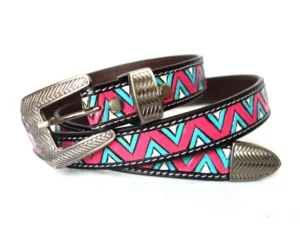
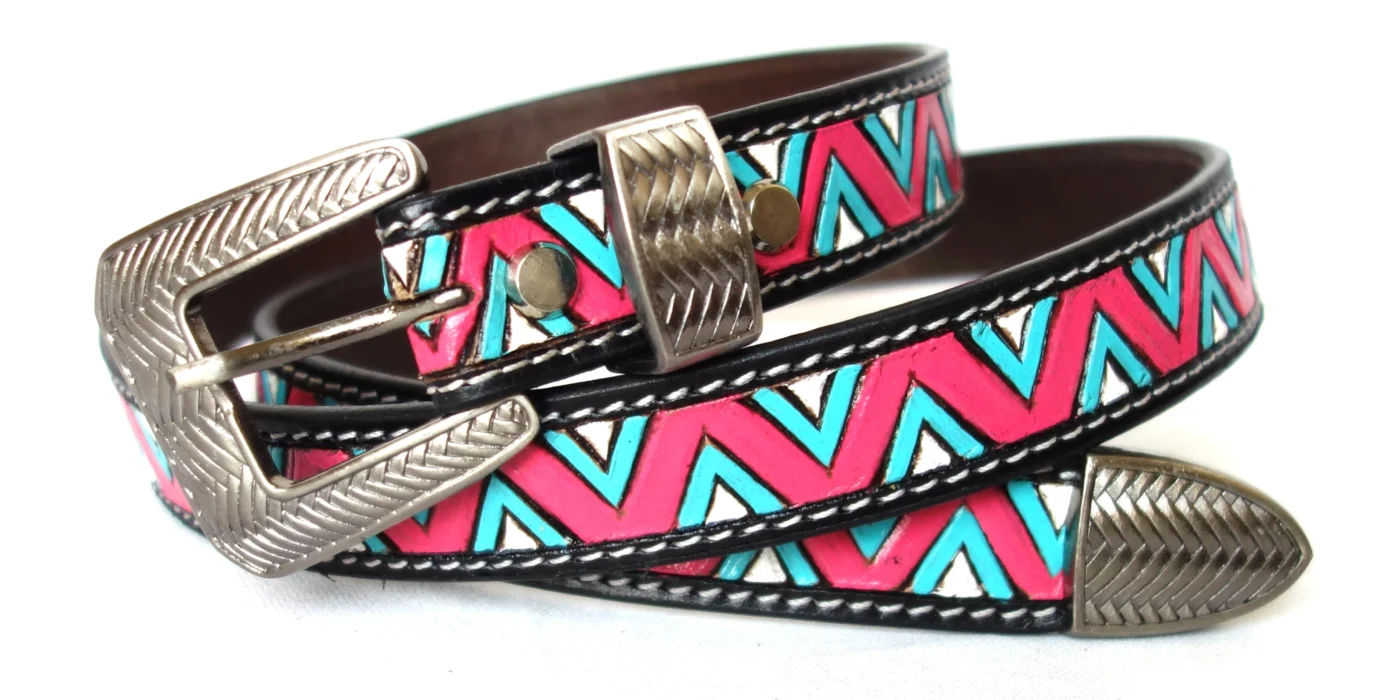
Geometric pink and turquoise zigzag handmade leather belts with contrast stitching.
Western leather belt designed with bold pink and turquoise geometric chevron inlays, white edge stitching, and textured silver-tone hardware.

3. Hardware Matters: Choosing Solid Brass & Stainless Steel

A durable belt requires hardware of equal strength. Cheap retail belts rely on zinc alloy or nickel-plated pot metal that easily snaps.

  • Solid Brass: The industry standard for heritage accessories. Brass will never rust, withstands severe tension, and develops an antiqued patina matching full-grain leather. Check out our [Link: Solid Brass Buckle Belts Collection].

  • Stainless Steel: Rust-proof and sweat-resistant, making it ideal for heavy-duty workwear and minimalist casual styles.

  • Interchangeable Chicago Screws: Threaded fasteners allow you to switch buckles in seconds without damaging the leather strap.

4. Belt Width, Thickness, and Style Guide

Selecting the right handmade belt requires matching dimensions to your trousers and use case.

Style / Use Case Recommended Width Leather Thickness (Oz / mm) Buckle Type
Dress & Formal Suits 1.25 inches (32 mm) 7–8 oz (2.8–3.2 mm) Sleek polished brass or stainless steel
Everyday Casual (Jeans/Chinos) 1.50 inches (38 mm) 9–10 oz (3.6–4.0 mm) Antiqued roller buckle
Heavy-Duty Workwear & Utility 1.50 to 1.75 inches 12–14 oz (4.8–5.5 mm) Heavy-duty double prong or utility roller
Western & Casual Heritage 1.50 to 1.75 inches 10–12 oz (4.0–4.8 mm) Engraved floral or custom silver buckle

Looking for a daily option? Browse our [Link: Everyday Casual Leather Belts (1.5 Inch)].

5. How to Find Your True Belt Size (The Standard Sizing Rule)

One of the most common mistakes is ordering the same size as your pants.

The Standard Sizing Rule: Always order a belt 2 inches larger than your actual pant waist size.

If you wear size 34 jeans, your handmade belt size is 36.

[Belt Buckle Fold] ======================================== (Center Hole) ==== (End Tip)
                   |<-------------- 36 Inches ------------->|
                   |       (Matches 34" Pant Size + 2")      |

Why the +2 Rule Works

  • Pant sizing runs small and doesn’t account for tucked shirts or material thickness.

  • A proper belt fastens in the middle hole (the 3rd of 5 holes), giving you adjustment room in both directions.

Measuring an Old Belt

  1. Lay your current belt flat on a table.

  2. Measure from the inside edge of the buckle frame to the hole you currently use.

  3. That length in inches is your true belt size.

Need more sizing details? Read our full [Link: Complete Leather Belt Sizing Guide].

6. Maintenance and Care: Making Leather Last a Lifetime

Vegetable-tanned leather is resilient, but simple maintenance keeps the fibers flexible:

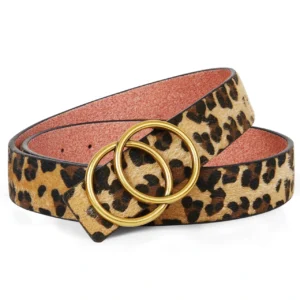
Leopard print calf hair handmade leather belts with gold double-ring circle buckle.
Women’s leopard print calf hair leather belt featuring interlocking gold-tone double-ring circular buckles.
  1. Keep It Clean: Wipe away sweat and dust with a damp microfiber cloth. Never soak leather in water.

  2. Condition Periodically: Apply a quality conditioner or neatsfoot oil once or twice a year to keep fibers hydrated. Learn more in our [Link: Leather Care and Conditioning Guide].

  3. Air Dry Naturally: If soaked in rain, let it air dry away from heaters and direct sunlight to prevent leather shrinkage and cracking.

  4. Hang Properly: Hang the belt vertically by its buckle or loosely coil it. Avoid tight rolling or bending against the grain.

Final Thoughts

A handmade full-grain leather belt is more than just a functional accessory—it is an investment in sustainable craftsmanship that looks better every year.

Ready to upgrade your everyday carry? Explore our handcrafted collection of [Link: Premium Handmade Full-Grain Leather Belts] and find the perfect fit for your style.

Handcrafted leather belt with pink, turquoise, and white chevron pattern and silver buckle.

Leather Belt in UK : Complete Buying Guide for Businesses

Let’s be honest for a second: most people don’t think about buying a good leather belt in UK until it either snaps mid-meeting, starts peeling like an old onion, or looks so worn out it ruins an otherwise sharp suit. Finding a reliable, handcrafted leather belt shouldn’t be an afterthought—it’s the anchor of your entire outfit.

Faux-fur leopard print leather belt with double gold O-ring buckle.
Make a bold statement! Leopard print leather belt featuring classic double gold ring hardware

Premium full-grain leather belts in assorted colors and finishes, perfect for formal and smart-casual wear.

In the retail, corporate, and fashion worlds across the UK, leather belts are often treated as an afterthought—just a tiny SKU tucked away in the accessories corner. But if you’re running a boutique, stocking a corporate gifting line, or sourcing uniforms for a hospitality workforce, that “tiny accessory” carries huge weight.

When done right, a high-quality leather belt in UK range delivers impressive profit margins, builds brand loyalty, and keeps customers coming back year after year. When done wrong, you’re left with inventory full of cracked PU leather, angry returns, and a tarnished reputation.

Whether you’re an independent retailer looking to explore quality fashion accessories{target=”_blank”}, a private-label fashion brand sourcing a new line, or a procurement manager looking for long-lasting uniform accessories, here is your no-nonsense guide to sourcing a premium leather belt in UK: Everything you need to know before buying.

1. Why the UK Leather Belt Market is Boom-Ready Right Now

The UK fashion and accessories landscape has shifted dramatically over the past few years. British consumers are tired of fast fashion that falls apart after three months. Instead, they are actively hunting for durability, repairability, and real craftsmanship.

Plaintext

Fast Fashion (PU / Bonded)         Modern Heritage (Full Grain / Veg-Tanned)
├── Cracks after 6 months           ├── Ages into a rich patina over years
├── High return rates               ├── Low return rates, high repeat purchases
└── Purely disposable               └── High perceived value & trade margin

What’s Driving Demand for a Genuine Leather Belt in UK?

  • The “Buy Less, Buy Better” Movement: UK buyers want pieces that last. Full-grain and vegetable-tanned leather belts fit this demand perfectly because they develop a rich patina over time rather than degrading.

  • Corporate Gifting Evolution: Standard plastic swag is out. Premium, custom-embossed leather accessories are in. Companies want corporate gifts that executives actually use daily.

  • Workwear & Smart-Casual Blurring: As UK dress codes relax across offices in London, Manchester, and Edinburgh, belts have become the bridge between tailored trousers and dark denim.

2. Unmasking Leather Grades for Handcrafted Leather Belts

If you’re sourcing belts for your business, you cannot afford to get tricked by vague supplier buzzwords. The term “Real Leather” on a spec sheet can mean anything from top-tier hide to glued-together leather dust.

Here is how the hierarchy actually breaks down so you know exactly what you’re paying for:

Handcrafted leather belt with pink, turquoise, and white chevron pattern and silver buckle.
Vibrant Southwestern vibe! Handcrafted leather belt featuring colorful chevron detailing and carved metal hardware.

Leather quality and durability comparison chart.

Leather Type What It Actually Is Durability Best Business Use Case
Full-Grain Leather The top layer of the hide with all natural grain intact. Unaltered, strongest, and ages beautifully. 10+ Years Luxury retail, heritage brands, premium gifts.
Top-Grain Leather Outer layer lightly sanded to remove imperfections, then coated or embossed. 3 to 7 Years Mainstream fashion retail, smart-casual dress belts.
Genuine / Split Leather The lower layers of the hide, often painted or stamped with a fake grain. 1 to 2 Years Budget retail, fast-turnaround promo items.
Bonded / Reconstituted Shredded leather scraps glued together with polyurethane binders. Months Avoid for business sourcing—high risk of peeling.

Pro Tip for B2B Buyers: If a supplier quotes you a suspiciously low wholesale price for a leather belt in UK, ask specifically whether it’s full-grain, split leather, or bonded. A low return rate relies entirely on sourcing full-grain or high-grade top-grain hides.

3. Tanning & Craftsmanship: Vegetable-Tanned vs. Chrome-Tanned UK Leather Belts

Vegetable Tanning (The Artisanal Choice)

  • Process: Tanned using natural plant tannins (bark, leaves, roots) over weeks or months.

  • Look & Feel: Stiffer initially, smells organic, and ages into a deep, glossy patina.

  • Why Businesses Love It: Highly eco-conscious narrative, premium appeal, and unmatched long-term structure.

Chrome Tanning (The Industrial Choice)

  • Process: Tanned quickly using chromium salts.

  • Look & Feel: Softer right out of the box, holds bright uniform colors (blues, reds, pastels) exceptionally well.

  • Why Businesses Love It: Lower production costs, faster turnarounds, and consistent color matching for high-volume orders.

4. Belt Dimensions & Specifications for Leather Belts in UK

Plaintext

Formal Dress Belt      [== 30mm / 1.25" ==]  --> Tailored Suits / Tuxedos
Smart Casual Belt     [=== 35mm / 1.38" ===]  --> Chinos, Slacks, Blazers
Casual Workwear Belt  [==== 38mm-40mm ====]  --> Heavy Denim, Utility Wear

Standard Width Guidelines for a Leather Belt in UK

  • Formal Dress Belts (28mm – 32mm / ~1.25 in): Slim, elegant profile meant for formal suit trousers and dress pants.

  • Everyday Office & Smart Casual (35mm / ~1.38 in): The single best-selling width for a leather belt in UK. Works seamlessly with both suit trousers and chinos.

  • Casual & Denim Belts (38mm – 40mm / ~1.5 in): Thick, sturdy belts designed for jeans, cargo trousers, and heavy-duty workwear.

Thickness Matters (MM vs. Ounces)

  • Lightweight (2.8mm – 3.2mm): Flexible, ideal for women’s fashion belts or dress belts.

  • Medium Duty (3.5mm – 4.0mm): The sweet spot for men’s casual and business belts. Sturdy without feeling bulky.

  • Heavyweight (4.0mm+): Ultra-durable, best for raw denim enthusiasts and heavy work environments.

Premium leather belt with an elegant gold finish.

5. Sizing & Fit: How to Sell Every Leather Belt in UK Without Returns

Sizing is the #1 cause of e-commerce returns in accessories. If your size guide is confusing, your returns will skyrocket.

Rule of Thumb: Belt Size = Waist / Trouser Size + 2 Inches

Example: 34″ Trouser Waist –> Order a 36″ Belt

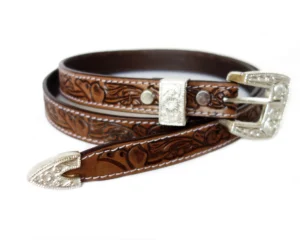
Hand-tooled brown leather belt with floral tooling and engraved silver buckle tip hardware.
Pure vintage elegance. Hand-carved brown leather belt with detailed floral tooling and silver accents.

The Standard 5-Hole Setup

A standard leather belt in UK range features 5 holes spaced 1 inch (2.5 cm) apart. The ideal fit lands the buckle tongue right in the middle hole (3rd hole). This leaves two holes for tightening and two holes for loosening.

UK Size Ratio Matrix for Business Ordering

When stocking a balanced retail assortment of handcrafted leather belts, use this general sizing distribution for every 100 belts:

  • Small (30-32″): 15%

  • Medium (34-36″): 40% (Core demand)

  • Large (38-40″): 30% (Core demand)

  • X-Large (42-44″): 15%

6. Sourcing & Private Labeling: Buying a Wholesale Leather Belt in UK

If you are expanding your brand, offering private-label accessories, or bulk-buying for retail, here are the essential factors to negotiate with manufacturers:

Minimum Order Quantities (MOQs)

  • UK-Based Stockists & Wholesalers: Often offer low MOQs (e.g., 5–50 units per style), ideal for testing the market or stocking smaller boutiques.

  • Overseas / Direct Factory Orders: Lower unit cost, but MOQs typically range from 300 to 1,000 units per color/style.

Hand-tooled western leather belt with turquoise accents, silver studs, and engraved metal buckle.
Bold western craftsmanship. Hand-carved leather belt with turquoise inlay and silver studding.

Hardware & Customization Options

Don’t neglect the hardware! A top-tier hide attached to a flimsy, lightweight zinc-alloy buckle will ruin the product experience.

  • Solid Brass: Heavy, durable, and develops a beautiful vintage tone over time.

  • Stainless Steel: Rust-resistant, modern, sleek silver finish.

  • Custom Embossing: Adding your logo via hot foil stamping, blind debossing, or custom buckle engraving increases retail margins significantly.

7. Practical Checklist Before Ordering Your UK Leather Belt Range

Before signing off on a bulk sample or purchase order, run through this final checklist:

Timeless craftsmanship. Classic tan & deep brown leather belts, built to last.

  • Check the Edges: Are the belt edges burnished, painted, or raw? Painted edges look clean initially but can peel if sub-par paint is used. Burnished edges (sanded and sealed with wax) last longer.

  • Inspect the Buckle Attachment: Is the buckle fixed with heavy-duty Chicago screws or cheap press studs? Screws allow for quick buckle replacements or belt shortening.

  • Verify Compliance: Ensure the leather meets UK and EU REACH standards (free from harmful chemicals like hexavalent chromium).

  • Test the Grain Flex: Bend a sample loop outward. If small cracks appear on the top surface, it’s a coated or bonded product that won’t hold up.

X
Add to cart