Handmade Leather Belts

The Ultimate Guide to Handmade Leather Belts: Quality, Craftsmanship, and Style

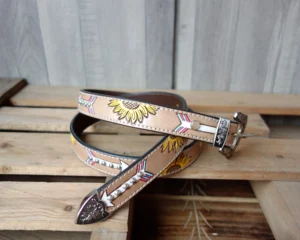
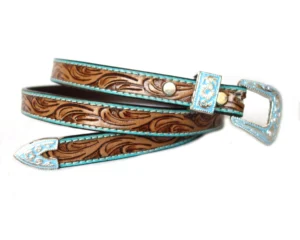
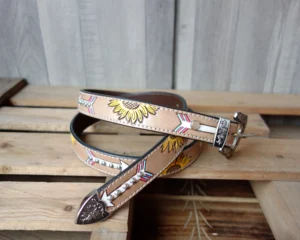
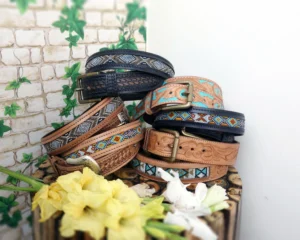
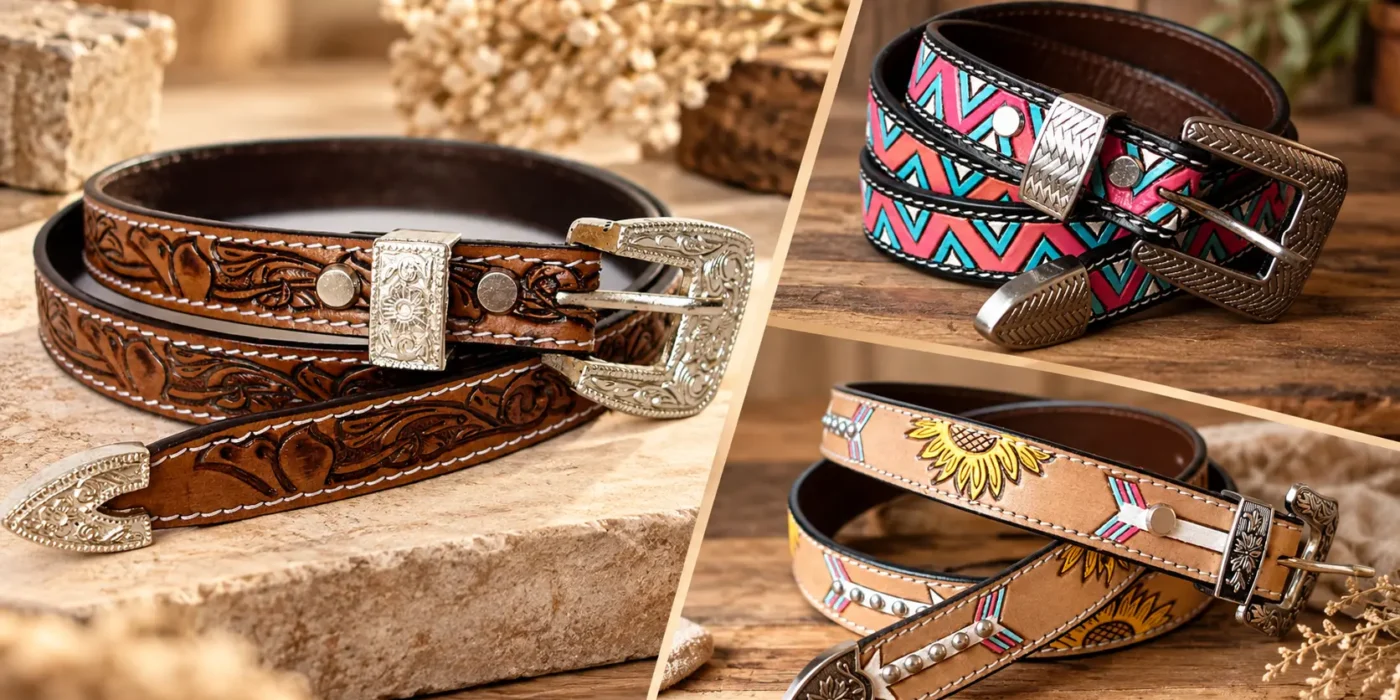
Hand-painted sunflower handmade leather belts with western arrow tooling and silver buckle.
Handcrafted western tan leather belt styled with painted sunflowers, studded arrow accents, and vintage metal hardware.


Fast fashion often dominates the retail market, pushing cheap accessories built to last only a few months. In contrast, authentic handmade leather belts stand as a testament to durability, individual craftsmanship, and functional design. Investing in premium handmade leather belts ensures you receive an accessory that matures gracefully with age, developing a rich patina that reflects daily wear and timeless utility.

If you are looking to upgrade your wardrobe with a durable staple, exploring our collection of [Link: Men’s Handmade Leather Belts Collection] is the best place to start.

1. The Anatomy of Real Leather: Understanding Grades and Tanning

Not all leather belts offer equal quality. The overall quality, flexibility, and lifespan of leather belts depend entirely on the raw hide grade selected and the tanning process applied by the artisan.

Leather Grades Explained

  • Full-Grain Leather (The Gold Standard): Cut directly from the top layer of the hide right below the hair. High-end leather belts made from full-grain hide retain natural grain markings and the tightest fiber density. Because the surface is un-sanded and un-buffed, [Link: Full-Grain Leather Belts] offer maximum breathability and tensile strength, developing an unmatched vintage patina over time.

  • Top-Grain Leather: The second-highest grade used in mid-tier leather belts. The surface layer is lightly sanded to buff away blemishes, followed by a protective finish coating. While flexible and uniform, top-grain leather belts lack the long-term structural integrity and rich aging properties of full-grain hides.

  • Genuine Leather (Split Leather): Despite the misleading name, commercial leather belts labeled as “genuine leather” use the bottom split layers of the hide. Coated with synthetic polyurethane and embossed with fake grain patterns, these leather belts stretch, peel, and break under regular tension.

  • Bonded Leather: Constructed from shredded leather scraps glued together using polyurethane bonding agents. Low-cost leather belts made from bonded material deteriorate rapidly and are never used in authentic artisanal leathercraft.

Vegetable Tanning vs. Chrome Tanning

Feature Vegetable Tanned Leather Belts Chrome Tanned Leather Belts
Tanning Agent Natural tree barks, roots, and plant tannins Chromium salts and synthetic chemicals
Process Duration 4 to 8 weeks of slow soaking 1 to 2 days
Feel & Structure Firm and rigid initially; molds perfectly to your body Soft and pliable immediately
Environmental Impact Biodegradable and eco-friendly Heavy chemical waste footprint
Patina Development Rich, darkening patina with age Minimal to none
Best Used For Heavy-duty everyday leather belts, holsters, saddlery Soft jackets, car upholstery, fast fashion

Handcrafted accessories rely heavily on [Link: Vegetable Tanned Leather Goods] because natural tannins provide the exact thickness and rigidity required for heavy-duty leather belts to hold trousers securely without sagging.

2. Step-by-Step: How Handmade Leather Belts Are Crafted

The production of artisanal leather belts differs fundamentally from automated factory assembly lines. Every individual piece among handcrafted leather belts is cut, beveled, edged, and finished by hand.

+-------------------------------------------------------------+
|                     1. Hide Selection                       |
|           (Heavy vegetable-tanned steer hide)               |
+------------------------------+------------------------------+
                               |
                               v
+-------------------------------------------------------------+
|                     2. Strap Cutting                        |
|       (Precision-cut to width: 1.25", 1.5", or 1.75")       |
+------------------------------+------------------------------+
                               |
                               v
+-------------------------------------------------------------+
|                    3. Edge Beveling                         |
|         (Shaving sharp corners for smooth comfort)          |
+------------------------------+------------------------------+
                               |
                               v
+-------------------------------------------------------------+
|                   4. Punching & Slotting                    |
|      (Oval sizing holes + elongated buckle-tongue slot)     |
+------------------------------+------------------------------+
                               |
                               v
+-------------------------------------------------------------+
|             5. Saddle Stitching / Hardware Assembly         |
|      (Hand-stitched waxed thread or solid Chicago screws)   |
+------------------------------+------------------------------+
                               |
                               v
+-------------------------------------------------------------+
|               6. Edge Burnishing & Finishing                |
|      (Beeswax friction polish for glass-smooth edge)        |
+-------------------------------------------------------------+

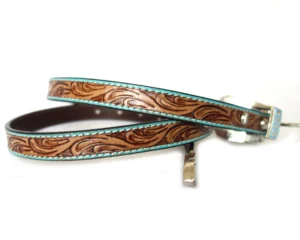
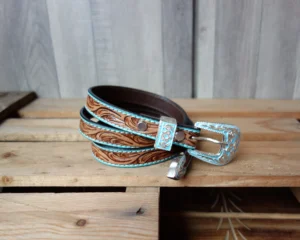
Hand-tooled western floral handmade leather belts with turquoise inlay and silver studs.
Hand-tooled western leather belt accented with vibrant turquoise inlay, silver studs, and a textured chevron buckle set.

Step 1: Hide Selection and Strap Cutting

An artisan starts with an unblemished piece of heavy vegetable-tanned steer hide (typically 9–10 oz thickness). Using a draw gauge strap cutter, strips are sliced along the densest part of the back to eliminate stretch.

Step 2: Edge Beveling

Raw cut edges have sharp corners. Craftsmen use an edge beveler tool to pare down the edges, creating a rounded, comfortable contour.

Step 3: Punching Holes and Buckle Slots

Artisans use specialized punches for precision:

  • English Point Punches to contour the belt tip.

  • Oblong Bag Punches for the buckle tongue channel.

  • Oval Hole Punches for sizing holes. Oval holes allow the buckle tongue to lie flat without pinching or stretching the leather.

Step 4: Traditional Saddle Stitching

When perimeter stitching is applied, artisans use traditional two-needle saddle stitching with waxed thread. If one stitch breaks, the surrounding stitches remain locked in place—unlike machine lockstitches that unravel completely.

Step 5: Hardware Assembly

Buckles are secured using either solid metal rivets or threaded Chicago screws, allowing you to swap hardware effortlessly.

Step 6: Edge Burnishing & Sealing

The mark of high craftsmanship is a smooth, glass-like edge. The edges are rubbed with natural compounds like Tokonole or gum tragacanth and friction-burnished with wooden slickers before being sealed with pure beeswax.

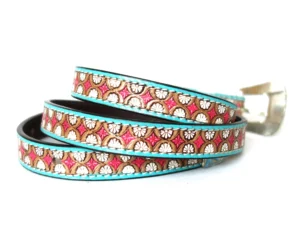
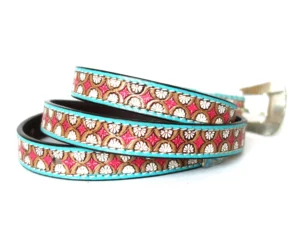
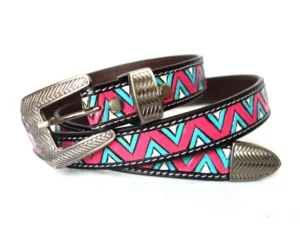
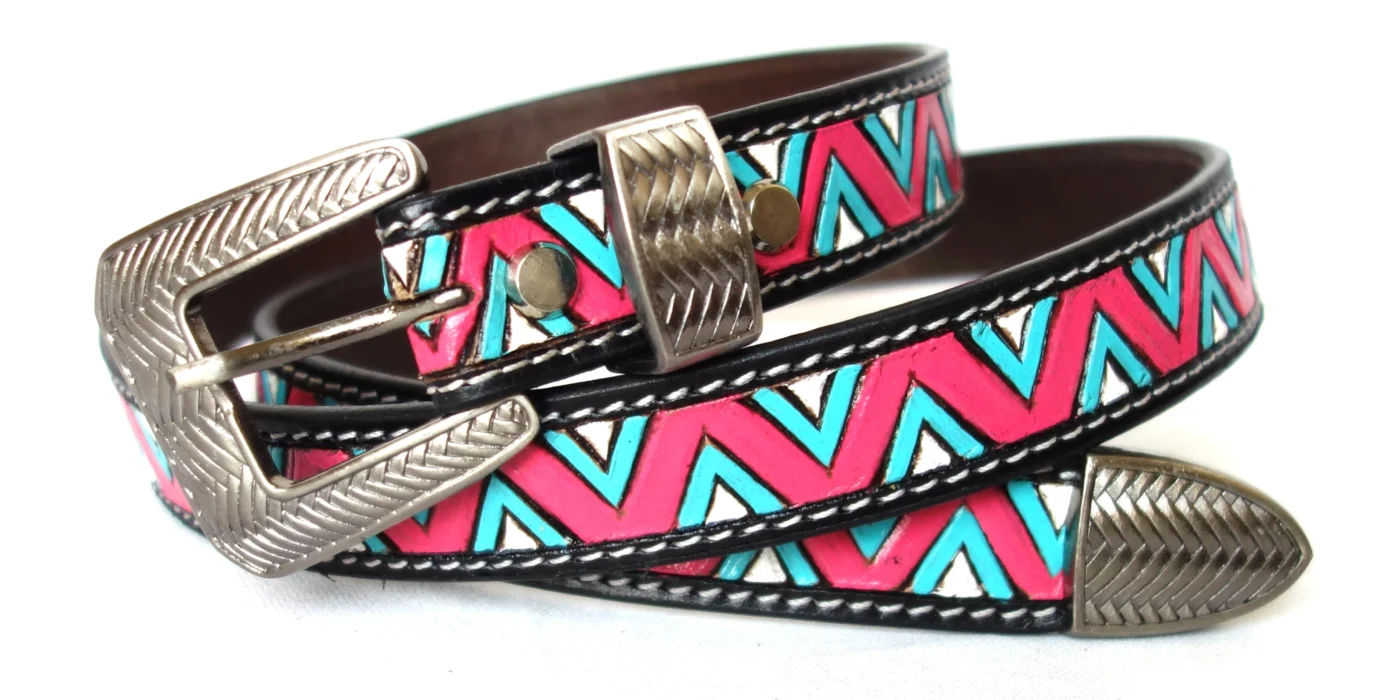
Geometric pink and turquoise zigzag handmade leather belts with contrast stitching.
Western leather belt designed with bold pink and turquoise geometric chevron inlays, white edge stitching, and textured silver-tone hardware.

3. Hardware Matters: Choosing Solid Brass & Stainless Steel

A durable belt requires hardware of equal strength. Cheap retail belts rely on zinc alloy or nickel-plated pot metal that easily snaps.

  • Solid Brass: The industry standard for heritage accessories. Brass will never rust, withstands severe tension, and develops an antiqued patina matching full-grain leather. Check out our [Link: Solid Brass Buckle Belts Collection].

  • Stainless Steel: Rust-proof and sweat-resistant, making it ideal for heavy-duty workwear and minimalist casual styles.

  • Interchangeable Chicago Screws: Threaded fasteners allow you to switch buckles in seconds without damaging the leather strap.

4. Belt Width, Thickness, and Style Guide

Selecting the right handmade belt requires matching dimensions to your trousers and use case.

Style / Use Case Recommended Width Leather Thickness (Oz / mm) Buckle Type
Dress & Formal Suits 1.25 inches (32 mm) 7–8 oz (2.8–3.2 mm) Sleek polished brass or stainless steel
Everyday Casual (Jeans/Chinos) 1.50 inches (38 mm) 9–10 oz (3.6–4.0 mm) Antiqued roller buckle
Heavy-Duty Workwear & Utility 1.50 to 1.75 inches 12–14 oz (4.8–5.5 mm) Heavy-duty double prong or utility roller
Western & Casual Heritage 1.50 to 1.75 inches 10–12 oz (4.0–4.8 mm) Engraved floral or custom silver buckle

Looking for a daily option? Browse our [Link: Everyday Casual Leather Belts (1.5 Inch)].

5. How to Find Your True Belt Size (The Standard Sizing Rule)

One of the most common mistakes is ordering the same size as your pants.

The Standard Sizing Rule: Always order a belt 2 inches larger than your actual pant waist size.

If you wear size 34 jeans, your handmade belt size is 36.

[Belt Buckle Fold] ======================================== (Center Hole) ==== (End Tip)
                   |<-------------- 36 Inches ------------->|
                   |       (Matches 34" Pant Size + 2")      |

Why the +2 Rule Works

  • Pant sizing runs small and doesn’t account for tucked shirts or material thickness.

  • A proper belt fastens in the middle hole (the 3rd of 5 holes), giving you adjustment room in both directions.

Measuring an Old Belt

  1. Lay your current belt flat on a table.

  2. Measure from the inside edge of the buckle frame to the hole you currently use.

  3. That length in inches is your true belt size.

Need more sizing details? Read our full [Link: Complete Leather Belt Sizing Guide].

6. Maintenance and Care: Making Leather Last a Lifetime

Vegetable-tanned leather is resilient, but simple maintenance keeps the fibers flexible:

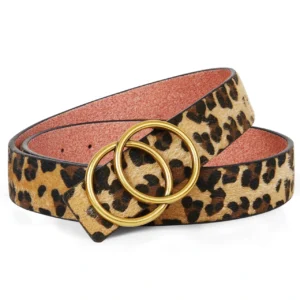
Leopard print calf hair handmade leather belts with gold double-ring circle buckle.
Women’s leopard print calf hair leather belt featuring interlocking gold-tone double-ring circular buckles.
  1. Keep It Clean: Wipe away sweat and dust with a damp microfiber cloth. Never soak leather in water.

  2. Condition Periodically: Apply a quality conditioner or neatsfoot oil once or twice a year to keep fibers hydrated. Learn more in our [Link: Leather Care and Conditioning Guide].
  3. Air Dry Naturally: If soaked in rain, let it air dry away from heaters and direct sunlight to prevent leather shrinkage and cracking.

  4. Hang Properly: Hang the belt vertically by its buckle or loosely coil it. Avoid tight rolling or bending against the grain.

Final Thoughts

A handmade full-grain leather belt is more than just a functional accessory—it is an investment in sustainable craftsmanship that looks better every year.

Ready to upgrade your everyday carry? Explore our handcrafted collection of [Link: Premium Handmade Full-Grain Leather Belts] and find the perfect fit for your style.

Handcrafted leather belt with pink, turquoise, and white chevron pattern and silver buckle.

Leather Belt in UK : Complete Buying Guide for Businesses

Let’s be honest for a second: most people don’t think about buying a good leather belt in UK until it either snaps mid-meeting, starts peeling like an old onion, or looks so worn out it ruins an otherwise sharp suit. Finding a reliable, handcrafted leather belt shouldn’t be an afterthought—it’s the anchor of your entire outfit.

Faux-fur leopard print leather belt with double gold O-ring buckle.
Make a bold statement! Leopard print leather belt featuring classic double gold ring hardware

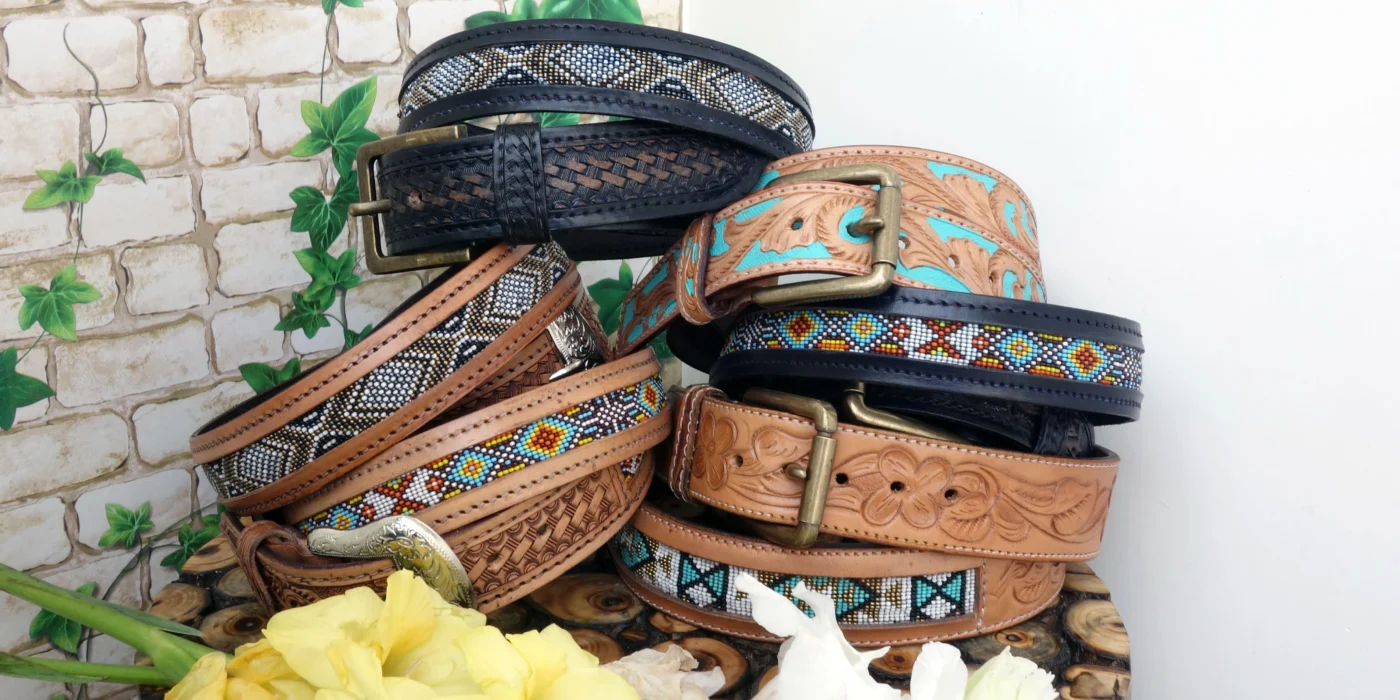
Premium full-grain leather belts in assorted colors and finishes, perfect for formal and smart-casual wear.

In the retail, corporate, and fashion worlds across the UK, leather belts are often treated as an afterthought—just a tiny SKU tucked away in the accessories corner. But if you’re running a boutique, stocking a corporate gifting line, or sourcing uniforms for a hospitality workforce, that “tiny accessory” carries huge weight.

When done right, a high-quality leather belt in UK range delivers impressive profit margins, builds brand loyalty, and keeps customers coming back year after year. When done wrong, you’re left with inventory full of cracked PU leather, angry returns, and a tarnished reputation.

Whether you’re an independent retailer looking to explore quality fashion accessories{target=”_blank”}, a private-label fashion brand sourcing a new line, or a procurement manager looking for long-lasting uniform accessories, here is your no-nonsense guide to sourcing a premium leather belt in UK: Everything you need to know before buying.

1. Why the UK Leather Belt Market is Boom-Ready Right Now

The UK fashion and accessories landscape has shifted dramatically over the past few years. British consumers are tired of fast fashion that falls apart after three months. Instead, they are actively hunting for durability, repairability, and real craftsmanship.

Plaintext

Fast Fashion (PU / Bonded)         Modern Heritage (Full Grain / Veg-Tanned)
├── Cracks after 6 months           ├── Ages into a rich patina over years
├── High return rates               ├── Low return rates, high repeat purchases
└── Purely disposable               └── High perceived value & trade margin

What’s Driving Demand for a Genuine Leather Belt in UK?

  • The “Buy Less, Buy Better” Movement: UK buyers want pieces that last. Full-grain and vegetable-tanned leather belts fit this demand perfectly because they develop a rich patina over time rather than degrading.

  • Corporate Gifting Evolution: Standard plastic swag is out. Premium, custom-embossed leather accessories are in. Companies want corporate gifts that executives actually use daily.

  • Workwear & Smart-Casual Blurring: As UK dress codes relax across offices in London, Manchester, and Edinburgh, belts have become the bridge between tailored trousers and dark denim.

2. Unmasking Leather Grades for Handcrafted Leather Belts

If you’re sourcing belts for your business, you cannot afford to get tricked by vague supplier buzzwords. The term “Real Leather” on a spec sheet can mean anything from top-tier hide to glued-together leather dust.

Here is how the hierarchy actually breaks down so you know exactly what you’re paying for:

Handcrafted leather belt with pink, turquoise, and white chevron pattern and silver buckle.
Vibrant Southwestern vibe! Handcrafted leather belt featuring colorful chevron detailing and carved metal hardware.

Leather quality and durability comparison chart.

Leather Type What It Actually Is Durability Best Business Use Case
Full-Grain Leather The top layer of the hide with all natural grain intact. Unaltered, strongest, and ages beautifully. 10+ Years Luxury retail, heritage brands, premium gifts.
Top-Grain Leather Outer layer lightly sanded to remove imperfections, then coated or embossed. 3 to 7 Years Mainstream fashion retail, smart-casual dress belts.
Genuine / Split Leather The lower layers of the hide, often painted or stamped with a fake grain. 1 to 2 Years Budget retail, fast-turnaround promo items.
Bonded / Reconstituted Shredded leather scraps glued together with polyurethane binders. Months Avoid for business sourcing—high risk of peeling.

Pro Tip for B2B Buyers: If a supplier quotes you a suspiciously low wholesale price for a leather belt in UK, ask specifically whether it’s full-grain, split leather, or bonded. A low return rate relies entirely on sourcing full-grain or high-grade top-grain hides.

3. Tanning & Craftsmanship: Vegetable-Tanned vs. Chrome-Tanned UK Leather Belts

Vegetable Tanning (The Artisanal Choice)

  • Process: Tanned using natural plant tannins (bark, leaves, roots) over weeks or months.

  • Look & Feel: Stiffer initially, smells organic, and ages into a deep, glossy patina.

  • Why Businesses Love It: Highly eco-conscious narrative, premium appeal, and unmatched long-term structure.

Chrome Tanning (The Industrial Choice)

  • Process: Tanned quickly using chromium salts.

  • Look & Feel: Softer right out of the box, holds bright uniform colors (blues, reds, pastels) exceptionally well.

  • Why Businesses Love It: Lower production costs, faster turnarounds, and consistent color matching for high-volume orders.

4. Belt Dimensions & Specifications for Leather Belts in UK

Plaintext

Formal Dress Belt      [== 30mm / 1.25" ==]  --> Tailored Suits / Tuxedos
Smart Casual Belt     [=== 35mm / 1.38" ===]  --> Chinos, Slacks, Blazers
Casual Workwear Belt  [==== 38mm-40mm ====]  --> Heavy Denim, Utility Wear

Standard Width Guidelines for a Leather Belt in UK

  • Formal Dress Belts (28mm – 32mm / ~1.25 in): Slim, elegant profile meant for formal suit trousers and dress pants.

  • Everyday Office & Smart Casual (35mm / ~1.38 in): The single best-selling width for a leather belt in UK. Works seamlessly with both suit trousers and chinos.

  • Casual & Denim Belts (38mm – 40mm / ~1.5 in): Thick, sturdy belts designed for jeans, cargo trousers, and heavy-duty workwear.

Thickness Matters (MM vs. Ounces)

  • Lightweight (2.8mm – 3.2mm): Flexible, ideal for women’s fashion belts or dress belts.

  • Medium Duty (3.5mm – 4.0mm): The sweet spot for men’s casual and business belts. Sturdy without feeling bulky.

  • Heavyweight (4.0mm+): Ultra-durable, best for raw denim enthusiasts and heavy work environments.

Premium leather belt with an elegant gold finish.

5. Sizing & Fit: How to Sell Every Leather Belt in UK Without Returns

Sizing is the #1 cause of e-commerce returns in accessories. If your size guide is confusing, your returns will skyrocket.

Rule of Thumb: Belt Size = Waist / Trouser Size + 2 Inches

Example: 34″ Trouser Waist –> Order a 36″ Belt

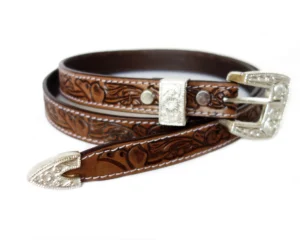
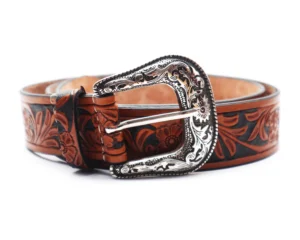
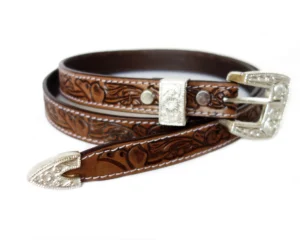
Hand-tooled brown leather belt with floral tooling and engraved silver buckle tip hardware.
Pure vintage elegance. Hand-carved brown leather belt with detailed floral tooling and silver accents.

The Standard 5-Hole Setup

A standard leather belt in UK range features 5 holes spaced 1 inch (2.5 cm) apart. The ideal fit lands the buckle tongue right in the middle hole (3rd hole). This leaves two holes for tightening and two holes for loosening.

UK Size Ratio Matrix for Business Ordering

When stocking a balanced retail assortment of handcrafted leather belts, use this general sizing distribution for every 100 belts:

  • Small (30-32″): 15%

  • Medium (34-36″): 40% (Core demand)

  • Large (38-40″): 30% (Core demand)

  • X-Large (42-44″): 15%

6. Sourcing & Private Labeling: Buying a Wholesale Leather Belt in UK

If you are expanding your brand, offering private-label accessories, or bulk-buying for retail, here are the essential factors to negotiate with manufacturers:

Minimum Order Quantities (MOQs)

  • UK-Based Stockists & Wholesalers: Often offer low MOQs (e.g., 5–50 units per style), ideal for testing the market or stocking smaller boutiques.

  • Overseas / Direct Factory Orders: Lower unit cost, but MOQs typically range from 300 to 1,000 units per color/style.

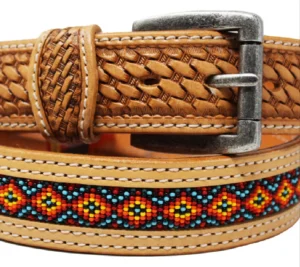
Hand-tooled western leather belt with turquoise accents, silver studs, and engraved metal buckle.
Bold western craftsmanship. Hand-carved leather belt with turquoise inlay and silver studding.

Hardware & Customization Options

Don’t neglect the hardware! A top-tier hide attached to a flimsy, lightweight zinc-alloy buckle will ruin the product experience.

  • Solid Brass: Heavy, durable, and develops a beautiful vintage tone over time.

  • Stainless Steel: Rust-resistant, modern, sleek silver finish.

  • Custom Embossing: Adding your logo via hot foil stamping, blind debossing, or custom buckle engraving increases retail margins significantly.

7. Practical Checklist Before Ordering Your UK Leather Belt Range

Before signing off on a bulk sample or purchase order, run through this final checklist:

Timeless craftsmanship. Classic tan & deep brown leather belts, built to last.

  • Check the Edges: Are the belt edges burnished, painted, or raw? Painted edges look clean initially but can peel if sub-par paint is used. Burnished edges (sanded and sealed with wax) last longer.

  • Inspect the Buckle Attachment: Is the buckle fixed with heavy-duty Chicago screws or cheap press studs? Screws allow for quick buckle replacements or belt shortening.

  • Verify Compliance: Ensure the leather meets UK and EU REACH standards (free from harmful chemicals like hexavalent chromium).

  • Test the Grain Flex: Bend a sample loop outward. If small cracks appear on the top surface, it’s a coated or bonded product that won’t hold up.

Premium genuine leather belt collection with handcrafted designs

Leather Belt in USA | Genuine Leather Belts for Men & Women

Leather Belt  is more than just a practical accessory—it’s a timeless fashion statement that combines durability, comfort, and style. Whether you’re dressing for the office, attending a formal event, or simply pairing jeans with a casual shirt, the right Leather Belt completes your outfit effortlessly. In the USA, premium leather belts have become a wardrobe essential for both men and women because of their versatility and long-lasting quality.

If you’re searching for a  Belt for Men, a stylish Belt for Women, or a handcrafted premium belt made from genuine leather, this guide will help you understand everything you need to know before making your purchase.

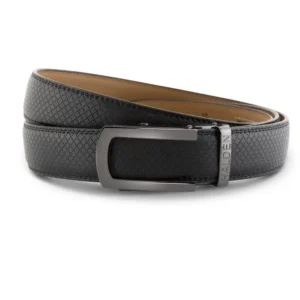
Handcrafted premium belt with engraved metal buckle
Elegant handcrafted leather belt with a premium engraved buckle.

Why Every Wardrobe Needs a Leather Belt

Fashion trends come and go, but a high-quality Leather Belt never goes out of style. Unlike synthetic belts that often crack or lose their shape within months, genuine leather develops a rich character over time, making it even more attractive with regular use.

Here are a few reasons why investing in a premium Belt is worth it:

  • Exceptional durability
  • Timeless appearance
  • Comfortable fit
  • Suitable for formal and casual outfits
  • Long-term value for money
  • Ages beautifully with use

Whether you’re buying your first belt or upgrading your collection, choosing a premium Leather Belt ensures years of dependable wear.

What Makes a Premium Leather Belt?

Not all leather belts are created equal. While many products claim to be genuine, understanding the difference between leather types helps you make a smarter investment.

Full-Grain Leather

Full-grain leather is considered the highest quality available. It retains the natural grain of the hide, making every Belt unique in texture and appearance.

Benefits include:

  • Superior strength
  • Natural finish
  • Rich patina over time
  • Excellent longevity

Top-Grain Leather

Top-grain leather is slightly refined to remove imperfections while maintaining durability. It offers a smooth, elegant finish that’s ideal for business and formal wear.

Genuine Leather

Despite the name, genuine leather is a lower grade than full-grain or top-grain leather. However, a well-crafted Genuine Belt for Men can still provide years of reliable use when properly maintained.

Bonded Leather

Bonded leather is made from leftover leather fibers mixed with adhesives. Although it’s more affordable, it doesn’t offer the same durability or premium feel as higher-quality leather.

For shoppers in the USA looking for lasting quality, investing in full-grain or top-grain leather is usually the best choice.

Leather Belt for Men: Style Meets Function

A premium Leather Belt for Men does much more than hold trousers in place. It enhances your overall appearance while reflecting personal style.

Popular styles include:

Formal Leather Belts

Perfect for:

  • Business suits
  • Office attire
  • Weddings
  • Corporate meetings

These belts typically feature:

  • Slim profile
  • Minimal stitching
  • Polished buckle
  • Black or dark brown finish

Casual Leather Belts

Casual belts work perfectly with:

  • Jeans
  • Chinos
  • Shorts
  • Weekend outfits

These often feature:

  • Wider straps
  • Rustic textures
  • Antique buckles
  • Handmade finishes

A premium Belt for Men easily transitions from workdays to weekends, making it one of the most versatile accessories you can own.

Leather Belt for Women: Elegant and Versatile

Today’s Belt for Women is available in countless designs that blend fashion with practicality.

Popular options include:

  • Thin waist belts
  • Wide statement belts
  • Classic jeans belts
  • Dress belts
  • Fashion buckle belts
  • Vintage leather belts

Women often use a premium Leather Belt to define the waistline, elevate dresses, or complete business attire.

Neutral shades like black, brown, tan, and cognac remain popular because they pair well with almost every wardrobe.

Classic brown genuine  belt with embossed floral design
Premium brown leather belt with elegant embossed detailing.

How to Identify an Original Leather Belt

One of the biggest concerns buyers have is distinguishing between a genuine product and an imitation. An Original Belt offers characteristics that are difficult for synthetic materials to replicate.

Look for these signs:

Natural Texture

Real leather has unique grain patterns. No two belts look exactly alike.

Rich Leather Smell

Authentic leather has a distinctive natural aroma that synthetic materials cannot imitate.

Flexible Feel

A premium Leather Belt bends naturally without showing cracks or peeling.

Strong Stitching

Quality craftsmanship includes neat, durable stitching and reinforced buckle attachments.

Quality Buckle

Premium belts often use stainless steel or solid alloy buckles that resist rust and maintain their finish over time.

Why Genuine Leather Is Worth the Investment

While synthetic belts may seem affordable initially, they often require frequent replacement. A well-made Leather Belt lasts for years, making it a smarter investment over time.

Benefits include:

  • Better appearance with age
  • Higher durability
  • Comfortable everyday wear
  • Eco-friendly longevity
  • Premium craftsmanship
  • Timeless fashion appeal

When shopping in the USA, many customers prefer handcrafted leather belts because they combine traditional craftsmanship with modern style.

Applications of a Premium Leather Belt

A Leather Belt is more than a fashion accessory. It serves practical and style-related purposes across different occasions, making it an essential part of every wardrobe. Whether you’re buying a  Belt for Men or a Belt for Women, choosing the right belt enhances both comfort and appearance.

1. Everyday Casual Wear

A casual Belt pairs perfectly with jeans, chinos, cargo pants, and shorts. It adds structure to your outfit while providing a relaxed yet stylish look.

Popular casual combinations include:

  • Blue jeans with a brown leather belt
  • Khaki chinos with a tan leather belt
  • Denim outfits with vintage leather belts

2. Business and Office Wear

A premium Leather Belt is an important accessory for professional dressing. Matching your belt with formal shoes creates a polished appearance suitable for meetings, presentations, and office environments.

Ideal choices include:

  • Black leather belts with black dress shoes
  • Dark brown leather belts with brown oxfords
  • Minimal buckle designs for executive attire

3. Wedding and Formal Events

Formal occasions demand elegant accessories. A genuine Belt complements suits, tuxedos, and formal trousers while maintaining a sophisticated appearance.

Recommended options include:

  • Smooth full-grain leather
  • Classic silver buckle
  • Slim-profile dress belts

4. Travel and Outdoor Use

A durable Leather Belt is ideal for frequent travelers and outdoor enthusiasts. High-quality leather withstands daily wear while providing reliable support for trousers during long trips.

Many travelers prefer handcrafted leather belts because they remain comfortable throughout extended use.

5. Fashion Styling

Modern fashion embraces leather belts as statement accessories. A stylish Leather Belt for Women can define the waistline of dresses, oversized shirts, coats, and blazers, while a premium Belt for Men enhances both casual and smart-casual outfits.

6. Special Gift Option

A handcrafted Leather Belt makes an excellent gift for birthdays, anniversaries, Father’s Day, Mother’s Day, Christmas, or corporate gifting. Its timeless appeal ensures it remains useful for years.

Premium genuine belt collection with handcrafted designs
Handcrafted premium leather belts in unique styles and finishes.

How to Take Care of Your Leather Belt

A premium Belt can last for many years with proper care. Genuine leather naturally develops a beautiful patina over time, but only if it is maintained correctly.

Follow these simple care tips to keep your leather belt looking its best.

Keep It Dry

Although genuine leather is durable, prolonged exposure to water can damage its texture and flexibility.

If your belt gets wet:

  • Wipe it gently with a soft cloth.
  • Allow it to air dry naturally.
  • Never use direct heat from a hairdryer or heater.

Clean Regularly

Dust and dirt can accumulate on the surface of a Leather Belt over time.

Use:

  • A soft microfiber cloth
  • Mild leather cleaner
  • Circular cleaning motions
  • Avoid harsh household cleaners, alcohol, or bleach.

Condition the Leather

Leather loses natural oils over time. Applying a quality leather conditioner every three to six months helps maintain softness and prevents cracking.

Benefits include:

  • Improved flexibility
  • Enhanced shine
  • Longer lifespan
  • Protection against dryness

Store Properly

Store your Belt in a cool, dry place away from direct sunlight.

You can:

  • Hang it vertically
  • Roll it loosely
  • Keep it in a dust bag when not in use
  • Avoid folding the belt tightly, as this may create permanent creases.

Rotate Your Belts

If you wear the same Leather Belt every day, it experiences constant stress. Owning two or three quality belts and rotating them helps maintain their shape and extends their lifespan.

Precautions to Protect Your Leather Belt

Taking preventive measures can significantly increase the durability of your Belt.

Avoid Excess Moisture

Rain, humidity, and accidental spills can weaken leather fibers. Dry the belt immediately if exposed to water.

Keep Away from Direct Sunlight

Continuous exposure to sunlight can fade the leather color and cause it to become brittle.

Don’t Overstretch the Belt

Pulling the belt excessively or using the wrong size places unnecessary stress on the holes and buckle area. Always choose the correct belt size.

Avoid Contact with Chemicals

Perfumes, deodorants, sanitizers, oils, and cleaning chemicals may stain or damage leather surfaces. Apply these products before wearing your belt.

Protect the Buckle

Metal buckles can become scratched or tarnished if they come into contact with hard surfaces. Store belts separately to prevent buckle damage.

Avoid Overloading

Many people attach heavy keychains, pouches, or tools to their Leather Belt. Excessive weight can deform the leather and shorten its lifespan.

Conclusion

Choosing the right Leather Belt is about more than just matching your outfit—it’s about investing in quality, durability, and timeless style. A premium  Belt complements both formal and casual wardrobes, making it an essential accessory for everyday wear. Whether you’re searching for a Belt for Men, a stylish Belt for Women, or a handcrafted genuine leather option, selecting high-quality materials ensures years of reliable performance.

When shopping in the USA, pay attention to the leather type, buckle quality, craftsmanship, and proper sizing. A genuine leather belt not only offers superior comfort but also develops a rich patina over time, making it even more attractive with regular use. By following proper care and maintenance practices, your Belt can remain in excellent condition for many years.

If you’re looking for a combination of elegance, functionality, and long-lasting value, a premium Belt is always a worthwhile investment. Choose a belt that reflects your personality, matches your lifestyle, and delivers the durability you expect from genuine leather craftsmanship.

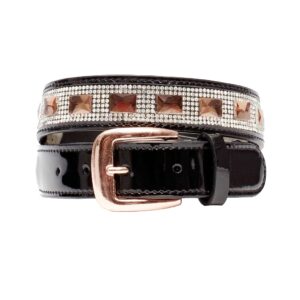
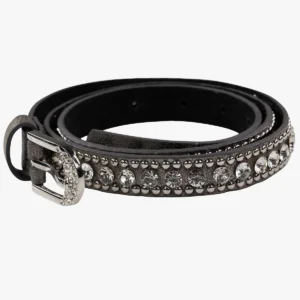
Women's black belt with crystal-studded buckle
Elegant women’s leather belt with sparkling crystal accents.

Frequently Asked Questions (FAQs)

1. How can I identify a genuine Leather Belt?

A genuine Leather Belt has a natural grain pattern, a distinctive leather smell, durable stitching, and develops a beautiful patina with age. It feels soft yet strong and won’t peel like synthetic materials.

2. Which Leather Belt is best for men?

The best Belt for Men depends on the occasion. Full-grain leather belts are ideal for long-term durability, while smooth black or brown dress belts are perfect for formal business attire. Casual leather belts with textured finishes pair well with jeans and chinos.

3. What is the difference between genuine leather and full-grain leather?

Full-grain leather is the highest-quality leather because it retains the natural surface of the hide, offering superior strength and durability. Genuine leather is still real leather but is made from lower layers of the hide and is generally more affordable.

4. Can women wear genuine leather belts for both casual and formal outfits?

Yes. A Belt for Women is highly versatile and can be styled with dresses, skirts, jeans, trousers, blazers, and coats. Slim belts work well for formal outfits, while wider belts create fashionable casual looks.

5. How do I choose the correct Leather Belt size?

Measure your waist or use your existing belt as a reference. Most experts recommend choosing a Belt that is 2 inches larger than your trouser waist size to ensure a comfortable fit.

6. How long does a premium Belt last?

A high-quality Belt made from full-grain or top-grain leather can last anywhere from 10 to 20 years or even longer with proper care and regular conditioning.

7. How should I clean and maintain my Leather Belt?

Clean your Belt using a soft cloth and a leather-safe cleaner. Apply a leather conditioner every few months to keep it moisturized, and store it in a cool, dry place away from direct sunlight and excessive moisture.

8. Is a Belt suitable for everyday use?

Absolutely. A premium Belt is designed for daily wear and offers excellent durability, comfort, and style. Rotating between two or three belts can help extend their lifespan.

9. What colors of Belt should I own?

For maximum versatility, consider owning:

  • Black Leather Belt for formal occasions
  • Dark Brown Leather Belt for business casual outfits
  • Tan or Cognac Leather Belt for casual wear
  • Burgundy or Navy Leather Belt for modern fashion styling
  • These colors cover almost every wardrobe combination.

10. Why should I invest in a premium Leather Belt instead of a synthetic belt?

A premium Belt offers superior durability, a timeless appearance, better comfort, and long-term value. Unlike synthetic belts that may crack or peel over time, genuine leather becomes softer and more attractive as it ages, making it a worthwhile investment.

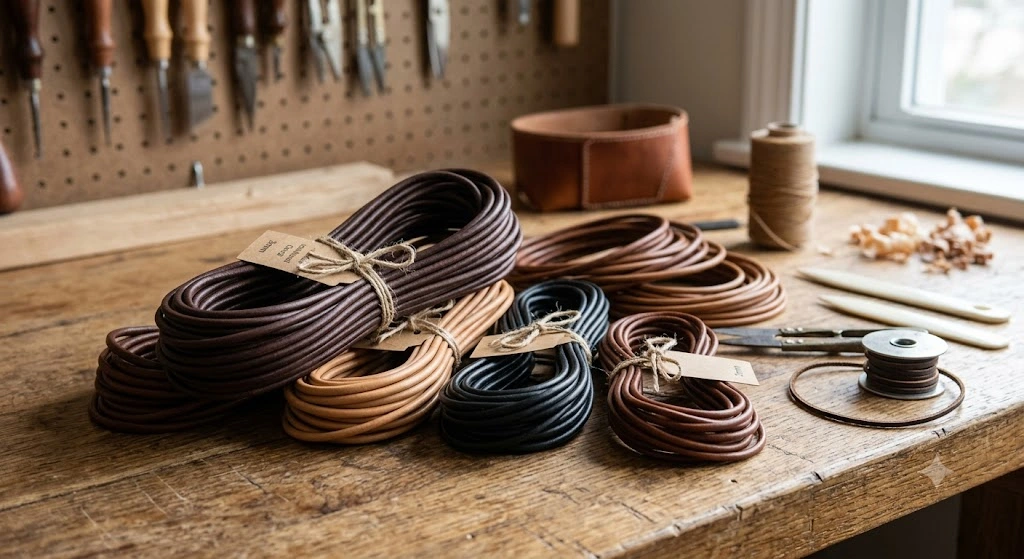
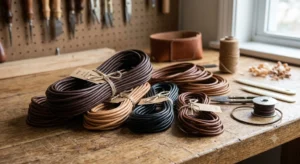
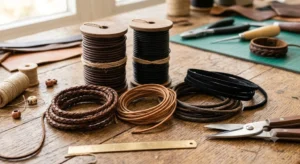
Bundles of dark brown, tan, and black leather cords on a wooden workbench.

Leather Cords in UK: Everything You Need to Know Before Buying A Complete Guide for Modern Businesses

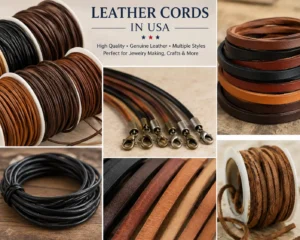
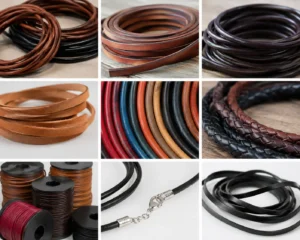
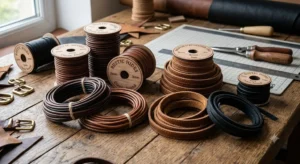
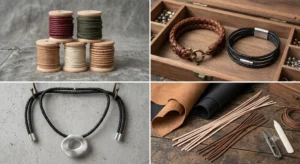
Product collage showing various genuine leather cords, flat leather strips, and spools in black and brown shades for crafts.
Craft with quality! ✨ Premium genuine leather cords in round, flat, and necklace styles for all your DIY projects.

Leather Cords in UK: Everything You Need to Know Before Buying A Complete Guide for Modern Businesses

If you are running a contemporary jewelry brand, designing luxury fashion accessories, or manufacturing bespoke leather goods across the United Kingdom, you already know that the devil is in the details. Whether you are stringing together rustic wrap bracelets, crafting high-end pet accessories, or accenting handcrafted furniture, your finished product is only as good as the core materials you use—and that means choosing high-quality lethers cords. 

That is where Leather Cords in UK: Everything You Need to Know Before Buying A Complete Guide for Modern Businesses comes in. In a market flooded with varying grades, synthetic lookalikes, and inconsistent sizing, finding the right wholesale leather cord supplier can make or break your product margins and brand reputation.

Grab a cuppa, sit back, and let’s dive into everything modern UK businesses need to know about sourcing, testing, and utilizing premium leather cords.

Why Leather Cords Remain a B2B Powerhouse Material

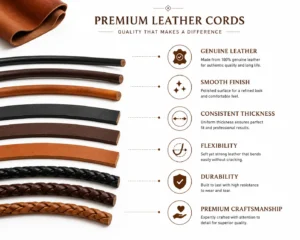
Despite the rise of synthetic fibers, silicone, and stainless steel chains, genuine leather cord continues to dominate modern product design. There is an undeniable tactile elegance to real leather that synthetic alternatives simply cannot replicate.

For UK businesses aiming for premium market positioning, real leather cords deliver key commercial benefits:

  • Unmatched Tensile Strength: Genuine animal hides feature tightly packed, interlocking collagen fibers that resist snapping under load.

  • The Graceful Patina: Unlike plastics that crack and peel over time, high-grade leather absorbs natural oils, developing a rich, unique patina as it ages.

  • Premium Perceived Value: Consumers consistently assign a higher price tag to handmade products crafted from authentic leather compared to faux alternatives.

  • Versatility Across Industries: From delicate 1mm beading thongs to heavy-duty 10mm braided cords, leather adapts to jewelry, apparel, bookbinding, upholstery, and leathercrafting.

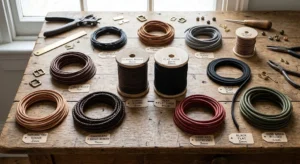
Alt Text: A 3x3 photo grid showcasing various styles, colors, and textures of leather cords and strips for crafting and jewelry making.
A versatile collection of leather cords, flat strips, and braided strands—perfect for DIY jewelry and leathercrafts.

The Main Types of Leather Cords for Commercial Production

When browsing UK wholesale catalogs, you will quickly notice that leather cords come in several distinct structural profiles. Selecting the right shape is crucial for structural integrity and aesthetic alignment.

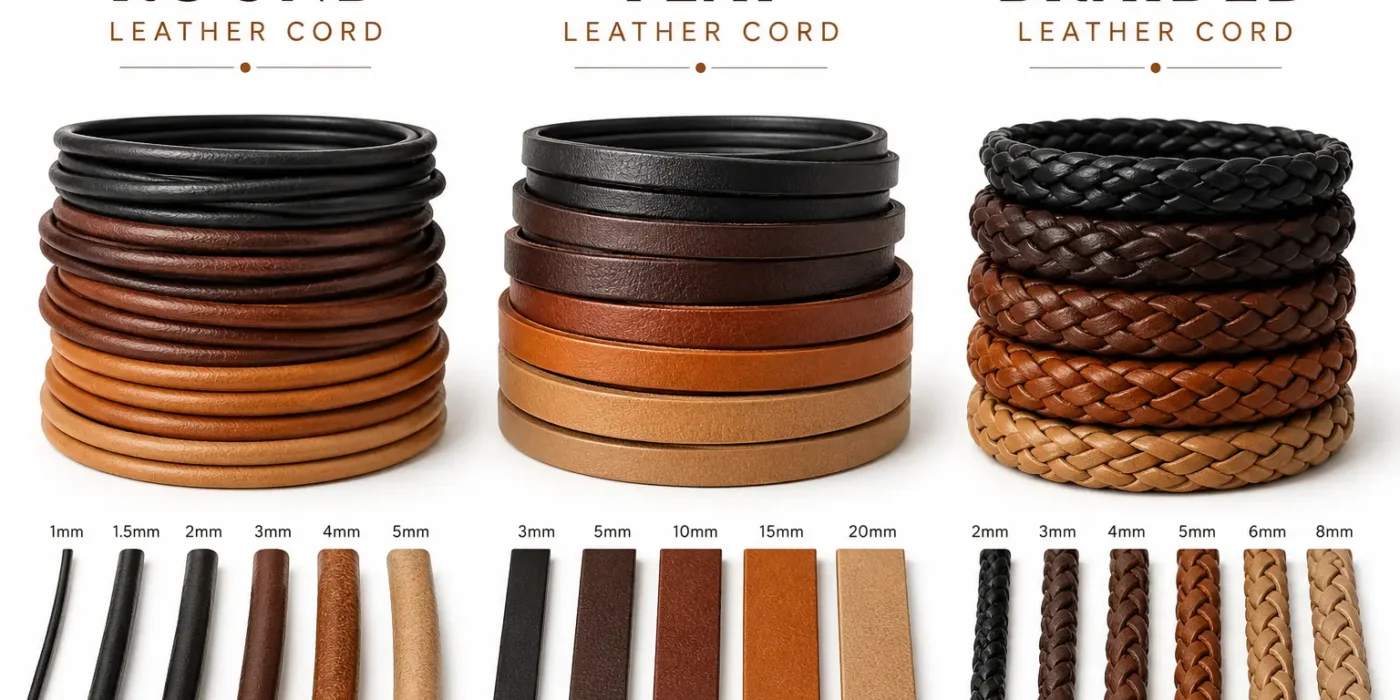
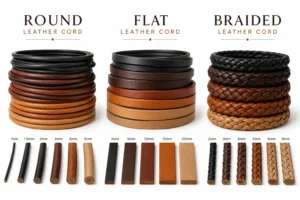
  TYPES OF LEATHER CORDS
  ├── Round Leather Cord (1mm - 10mm)  --> Ideal for neckwear, bracelets, beaded design
  ├── Flat Leather Cord (2mm - 10mm+)  --> Ideal for cuffs, belts, bag handles, footwear
  ├── Braided Leather Cord (Bolo/Round)--> Ideal for heavy-duty ties, dog leashes, luxury cuffs
  └── Nappa / Stitched Leather Cord   --> Ideal for high-end fashion & soft tactile luxury

1. Round Leather Cord

The absolute workhorse of the crafting and manufacturing world. Round leather cord is machine-cut or extruded to produce a perfectly cylindrical profile with continuous, smooth surface coverage.

  • Best Uses: Beaded necklaces, minimalist pendants, multi-wrap bracelets, and drawstring accents.

  • Available Gauges: Typically ranges from 0.5mm ultra-fine cord up to 10mm thick industrial strands.

2. Flat Leather Cord

If your design team is aiming for a bold, modern, or industrial aesthetic, flat leather cord (or leather lace) offers a broader surface area. This allows the natural grain and texture of the hide to take center stage.

  • Best Uses: Statement cuffs, watch bands, bag handles, shoe lacing, and garment trims.

  • Key Advantage: Lay-flat comfort against human skin or fabric surfaces.

3. Braided Leather Cord (Bolo Cord)

Created by tightly weaving multiple fine strands around a strong central core or hollow center. Braided leather cords (often referred to as braided bolo cords) combine flexible movement with striking visual texture.

  • Best Uses: Traditional western bolo ties, heavy-duty pet leashes, men’s luxury wrap bracelets, and decorative trims.

  • Key Advantage: Exceptional flexibility without sacrificing thickness or tensile strength.

4. Nappa Stitched Leather Cord

For high-end fashion houses and artisan jewelry makers, Nappa leather cord represents the peak of softness. It features ultra-soft full-grain sheepskin or lambskin folded and stitched seamlessly around a core.

  • Best Uses: Luxury bracelets, high-end eyewear retainers, and designer handbag straps.

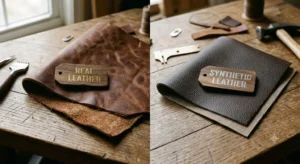
A side-by-side comparison on a wooden workbench: natural, distressed real leather with rough edges versus uniform, pebble-grained synthetic leather with a fabric backing,
A visual distinction: the left panel shows natural, full-grain real leather with its characteristic imperfections and soft underside, while the right panel displays a synthetic leather alternative, featuring a uniform texture and clear fabric backing.

Real Leather vs. Synthetic: What Modern UK Businesses Must Know

When sourcing supplies, you will inevitably come across low-cost synthetic options labeled as “PU Leather,” “Microfiber Leather,” or “Pleather”. While these might seem tempting for short-term cost savings, relying on synthetic cords can harm modern B2B operations.

The B2B Warning: Cheap PU or PVC cords are essentially plastic bonded to woven backing. Under daily wear, sweat, and exposure to sunlight, synthetic cords degrade rapidly, flaking and snapping within months. Real leather cord, when cared for properly, lasts for years and improves with age.

Feature Genuine Leather Cord Synthetic (PU/PVC) Cord
Material Origin Natural hide (Cow, Calf, Sheep) Petroleum-based plastics
Durability High tensile strength; resists snapping Prone to stretching and tearing under tension
Aging & Look Develops a rich patina over time Peels, flakes, and cracks with exposure
Tactile Experience Warm, flexible, natural texture Cold, stiff, plastic-like feel
Regulatory Standing Eco-tanned & REACH compliant options available Off-gasses microplastics & VOCs

Sizing & Dimension Guide for Commercial Production

One of the biggest headaches for product managers and workshop leads is ordering spools of leather cord that do not fit standard jewelry findings, clasps, or grommets. Gauge accuracy is vital in manufacturing.

Here is a handy reference guide to help your purchasing department pair the right cord size with appropriate applications and findings:

Diameter / Width Ideal Commercial Application Recommended Hardware / Clasps
1.0mm – 1.5mm Fine bead threading, intricate macramé, lightweight charms Small fold-over crimps, sliding knots, 1.5mm crimp tubes
2.0mm – 3.0mm The industry standard for wrap bracelets, classic pendant cords 2mm or 3mm stainless steel magnetic clasps, bayonet locks
4.0mm – 5.0mm Men’s chunky bracelets, heavy pendant cords, bag accents Screw-together caps, hook clasps, 4mm/5mm glue-in end caps
6.0mm – 10.0mm Heavy statement cuffs, dog leashes, handles, furniture lacing Wide magnetic locks, custom hardware, mechanical rivets

Sourcing Leather Cords in UK: Everything You Need to Know Before Buying A Complete Guide for Modern Businesses

Navigating supply chains requires a balanced look at compliance, quality control, and cost management. To keep your production running smoothly, keep these key factors in mind:

1. Compliance with UK & EU REACH Regulations

The United Kingdom enforces strict legal standards regarding chemical processing in consumer goods. If your products come into contact with human skin (like necklaces or bracelets), your leather cord must strictly comply with REACH regulation limits:

  • Azo Dyes: Must be free from carcinogenic aromatic amines.

  • Heavy Metals: Lead, nickel, and cadmium levels must fall below strict parts-per-million thresholds.

  • Hexavalent Chromium (Cr VI): Standard chrome-tanned leather can leach Cr VI if improperly treated; vegetable-tanned leather cords avoid this risk altogether.

Always ask your UK supplier for chemical compliance certification before issuing a purchase order.

2. Tanning Methods: Vegetable-Tanned vs. Chrome-Tanned

  • Vegetable-Tanned Leather Cords: Tanned using natural plant extracts, barks, and leaves. They are firm, hypoallergenic, eco-friendly, and age beautifully. Ideal for premium jewelry and leathercraft.

  • Chrome-Tanned Leather Cords: Tanned using chromium salts. They yield softer, more pliable leather in vivid synthetic colors. Great for garments, but require strict certification for skin safety.

3. Gauge Consistency and Tensile Quality Control

Mass-manufactured cord imported from unverified sources often suffers from terrible gauge variation. A spool labeled “2mm” might thin down to 1.5mm or swell to 2.8mm halfway through the roll.

When sourcing from reputable UK suppliers, look for guarantees on uniform diameter and continuous reel lengths (25m, 50m, or 100m spools) to avoid wasted material during automated or manual assembly.

4. Color Matching & Custom Batching

If your business manufactures items across multiple seasons, color consistency between batches is vital. Leading European and UK suppliers offer Pantone-matched custom dyeing and bulk production runs, ensuring your signature line of black, vintage brown, or vibrant fashion cords stays uniform year after year.

Bundles of dark brown, tan, and black leather cords on a wooden workbench.
Premium leather cords for artisan crafting.

Care & Maintenance Guidelines to Share with Your Customers

To maximize customer satisfaction and minimize product returns, equip your end-users with simple care instructions for their leather goods:

  1. Keep It Dry: Moisture is leather’s natural enemy. Advise customers to remove leather jewelry before showering, swimming, or exercising.

  2. Apply After Cosmetics: Perfumes, colognes, and hairsprays contain alcohol and solvents that strip natural oils from leather cords, leading to dryness and cracking.

  3. Condition Periodically: For high-wear items like dog leashes or heavy leather cuffs, applying a tiny drop of natural leather conditioner keeps the fibers supple for years.

Final Thoughts: Elevating Your Business with Premium Leather Cords

Understanding material grades, compliance standards, and structural styles gives your business a clear competitive edge in today’s market. By choosing certified, uniform, real leather cords, you ensure that every product leaving your workbench reflects quality craftsmanship and long-lasting durability.

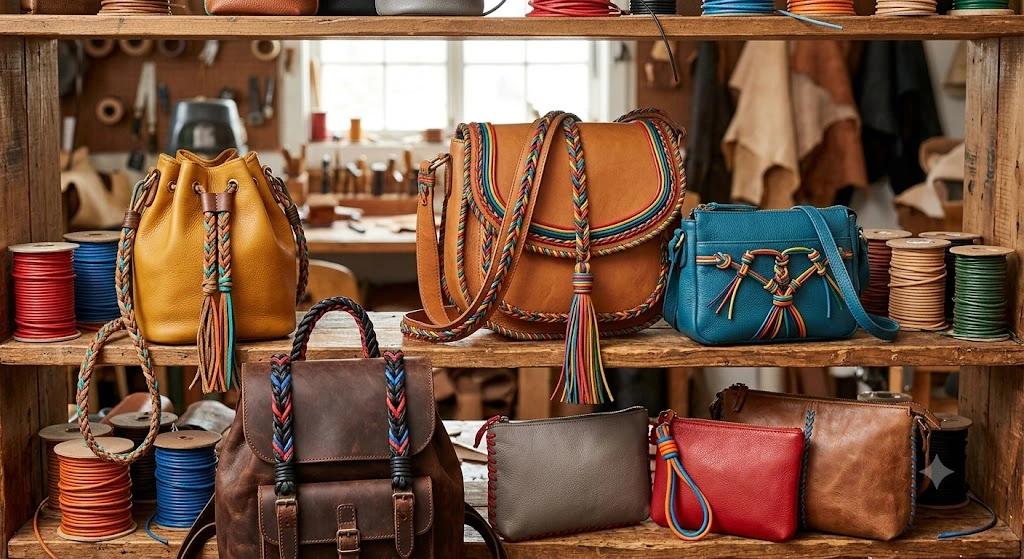
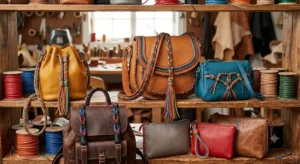
Crafted leather bags, totes, and backpacks on display in a studio

Real Leather Cord in UK

Assorted real leather cords in UK workshop including round and flat profiles
High-quality round, flat, and braided leather cords ready for crafting.

The Ultimate Guide to Working with Real Leather Cord: Styles, Techniques, and Crafting Secrets

If you are looking for high-quality Leather Cords in UK workshops and crafting spaces, finding material that won’t snap, fray, or look cheap can be a real challenge. Many crafters spend hours searching through craft boxes for the perfect stringing material, only to settle for synthetic faux-suede or stiff plastic cords that lack durability and style. Genuine leather offers something entirely different. Whether you’re creating a rugged multi-wrap bracelet, stringing a statement pendant, crafting a custom necklace, or adding decorative lacing to a leather project, Real Leather Cord provides exceptional strength, flexibility, and a timeless natural finish. Unlike synthetic alternatives, genuine leather develops a beautiful character over time, making it the preferred choice for jewelry makers, DIY enthusiasts, and professional leatherworkers across the UK.

For makers, designers, and hobbyists searching for quality leather cords in uk workshops, navigating the sheer variety of cuts, thicknesses, and finishes can feel a little overwhelming. Let’s break down everything you need to know about choosing, styling, and caring for genuine leather cord so your next handmade piece looks effortlessly professional rather than like a rushed school art project.

Why Choose Real Leather Over Synthetics?

Let’s be honest: fake PU leather or synthetic suede cords are cheap, but they come with a major expiration date. Within a few weeks of skin contact, cheap coatings start to peel, crack, and flake off, revealing a weak fabric or paper core underneath.

Real hide behaves completely differently. Genuine leather breathes, absorbs natural body oils over time, and develops a rich, buttery patina that only gets better the more you wear it.

  • Durability under tension: Full-grain and top-grain hides possess natural tensile strength. A solid strip of hide can withstand significant pulling forces without snapping.

  • Skin comfort: Unlike plastic-coated cords that trap sweat and stick uncomfortfully to the skin, natural leather remains breathable and soft.

  • Ageing gracefully: The friction of daily wear polishes real leather, deepening its tones and softening any initial stiffness.

Tanning Types: Vegetable-Tanned vs. Chrome-Tanned

Understanding how your hide was processed is key to picking the right material for your project. The two primary tanning methods yield very different handling properties:

Tanning Method Characteristics Best Uses
Vegetable-Tanned (Veg-Tan) Firm, holds shape, absorbs oils, patinas heavily, eco-friendly plant dyes. Braiding, structural wraps, molded loops, tool-stamped flat cords.
Chrome-Tanned Soft, pliable right out of the roll, highly water-resistant, rich vibrant colors. Garment lacing, soft neck cords, tassel fringes, flexible wrap bracelets.

Flat leather cord and classic round leather cord spools on a wooden crafting table
High-quality real leather cords in multiple sizes and colors, perfect for necklaces, bracelets, leathercraft, and DIY accessories.

Navigating the Lineup: Profiles and Styles

When you start browsing for materials, you will quickly notice that leather isn’t just sold in one uniform shape. Different styles serve completely different structural and aesthetic purposes.

1. Flat Leather Cord

A flat leather cord features a wide, low-profile footprint that rests cleanly and comfortably flat against the skin or garment surface. Because of its geometric shape, it refuses to twist, flip, or roll around when worn as a wrist cuff or choker.

  • Best used for: Wide wrap bracelets, rustic watch strap replacements, bookbinding spine ties, bag trim, and belt accents.

  • Pro styling tip: Because it distributes weight across a broader surface area, it’s ideal if you want to mount heavier metal sliders or riveted hardware without the band sagging or biting into the skin.

2. The Classic Round Profile

Round cord is the absolute bread-and-butter of the jewelry world. Sliced evenly from high-grade hides and rounded through precision dies, it offers a clean, organic look.

  • Best used for: Simple pendant drops, adjustable slip-knot necklaces, and minimalist beaded cuffs.

  • Pro styling tip: If you are shopping online and wondering how it compares to options you might casually browse on global retail hubs or hobby chains akin to a leather cord walmart or craft staples from a leather cord michaels storefront, always check the material specification. Look for vegetable-tanned or chrome-tanned full hide rather than glued leather dust composites, which snap easily when pulled tight.

3. Braided & Greek Leather Cord

Braided options combine multiple smaller strands interwoven around a core fiber. Greek leather, in particular, is renowned worldwide for its uniform round precision, exceptionally smooth finish, and tight weave.

  • Best used for: High-end nautical bracelets, rugged men’s chokers, and heavy-duty key fobs.

  • Pro styling tip: When cutting braided cord, wrap a small piece of masking tape tightly around the cut zone first, then slice through the middle of the tape. This stops the individual strands from unraveling while you attach end fittings.

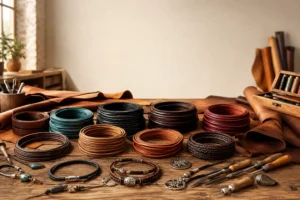
Crafting display with colorful leather cords, bags, and leatherworking tools
A complete guide to leather cords

Finding the Right Fit: Sizing Demystified

Thickness matters tremendously. Choose the wrong diameter, and your favorite beads won’t slide over the ends, or your necklace will end up looking like a heavy-duty dog leash.

  • Fine Diameters (1mm – 2mm): Micro cords are subtle, delicate, and lightweight. They work brilliantly for multi-wrap seed bead bracelets, detailed macramé leather knots, or stringing gemstone briolettes with tiny drill holes.

  • Mid-Range Cords (3mm – 4mm): This is the sweet spot for daily-wear pendant necklaces and standard single-strand charm bracelets. It has enough physical presence to stand on its own without needing bulky embellishments.

  • Heavy-Duty Scales (like a robust leather cord 6mm or larger): When you step up to a leather cord 6mm profile, you are entering heavy utility and statement territory. This thickness is fantastic for chunky men’s wristbands, heavy lanyards, or rugged drawstrings for waxed canvas rucksacks.

Color Psychology and the Power of Neutral Tones

The color of your leather sets the emotional and visual foundation for your design. While rich chestnuts, cognac tans, and vintage saddle browns offer a gorgeous, rustic, earth-toned charm, one shade stands undisputed as the ultimate workshop staple: leather cord black.

Why is a spool of leather cord black an absolute must-have in any maker’s kit?

  1. High contrast pop: Bright silver hardware, polished copper beads, and vibrant gemstone cabochons instantly jump out and command attention against a deep obsidian background.

  2. Seamless versatility: Black matches virtually any wardrobe palette, making it universally wearable for everyday accessories.

  3. Discreet transitions: When you are gluing end caps or tying complex knots, black hides minor adhesive blunders or friction wear much better than pale, sensitive tans.

Essential Knots Every Leather Crafter Must Master

You don’t always need metal clasps to finish off leather jewelry. In fact, traditional sliding knots often look cleaner and allow the piece to be resized effortlessly.

Crafted leather bags, totes, and backpacks on display in a studio
Handcrafted leather bags with premium braided leather cords for a stylish finish.

The Double Fisherman’s Sliding Knot (For Adjustable Necklaces)

This classic sliding knot lets the wearer pull the cord to tighten or loosen a necklace easily without hardware.

  1. Lay the two ends of your leather cord for necklace designs parallel to each other, pointing in opposite directions.

  2. Take the tail end on the right, wrap it back over both cords twice toward the right, forming two clean loops.

  3. Pass the tail back through both loops and pull tight to form a solid barrel knot.

  4. Repeat the process with the left tail end wrapping around the main right cord.

  5. Trim any excess tail flush with the knot, adding a micro-dot of clear flex-glue to secure the core.

The Sliding Sliding Button Loop

Ideal for flat cords or thick round strands where metal clasps look out of place:

  1. Double one end of the cord over to form a tight 1cm loop.

  2. Bind the base of the loop tightly with fine 1mm cord or waxed thread using a coil whip-stitch.

  3. On the opposite end, thread a hardwood or horn button. Securing the button inside the loop gives a clean, rustic closure.

Step-by-Step Projects

Project 1: Making a Minimalist Pendant Necklace

If you have a gorgeous focal pendant sitting in your studio and want to build a clean, modern necklace to showcase it, here is a quick guide using a sturdy 3mm round or flat strand.

What You Need:

  • 50cm of high-grade 3mm natural leather cord

  • 1 x Metal focal pendant with a bail loop larger than 3.5mm

  • 2 x Matching glue-in end caps

  • 1 x Lobster claw clasp and closing jump rings

  • Professional jewelry adhesive (such as a flexible two-part epoxy)

The Assembly Steps:

  1. Measure and cut: Wrap the raw cord loosely around your neck to test the drop length, allowing an extra 2cm for your end hardware fittings. Cut cleanly with sharp shears at a 90-degree angle.

  2. Thread the focal piece: Slide your statement pendant directly onto the center of the cord so it rests smoothly at the lowest point of the curve.

  3. Prep the ends: Dab a tiny drop of jewelry-grade epoxy inside your metal end caps. Push the trimmed leather ends firmly into the barrels, twisting slightly to ensure the glue coats the fibers evenly. Wipe away any immediate squeeze-out with a damp swab.

  4. Attach the clasp: Let the glue cure completely for at least 24 hours. Once set, attach your lobster clasp and jump rings to the loops of the end caps using flat-nose pliers.

Crafting a Multi-Strand Leather & Bead Wrap Bracelet

This double-wrap design pairs a 2mm leather cord black strand with natural stone beads for a sleek, layered wrist cuff.

What You Need:

  • 1.2 meters of 2mm round black leather cord

  • 30-40 x 6mm gemstone beads with 1.2mm+ drill holes

  • 1.5 meters of waxed nylon thread or fine leather cord

  • 1 x Metal shank button or toggle clasp

  • Beading needle and hypo-cement glue

The Assembly Steps:

  1. Form the base: Fold your 1.2m leather cord in half. Tie an overhand knot at the bend to create a loop just large enough to fit your shank button snugly.

  2. Secure the thread: Tie your waxed thread firmly onto the top strand right below the main knot.

  3. Weave the beads:

    • Thread a bead onto your needle.

    • Pass the needle over the top leather strand, through the bead, and under the bottom leather strand.

    • Pull snug so the bead sits firmly nested between the two parallel leather rails.

    • Loop the thread back over the bottom rail, through the same bead in reverse, and under the top rail to lock it in place.

  4. Repeat to length: Continue stringing beads until the woven section wraps twice comfortably around your wrist (approx. 34-36cm).

  5. Finish: Tie a secure multi-knot around both leather strands with your thread. Tie a final overhand knot in the main leather cord, leave a small button gap, and tie a second closing knot. Trim the excess tails cleanly.

Workshop Troubleshooting Guide: Fixing Common Leather Cord Issues

Even experienced crafters run into minor issues when working with natural hides. Here is how to handle the most common headaches:

  • Issue: The cord arrives with set kinks or tight curls from being spooled.

    • Solution: Dampen the cord lightly with warm water (do not soak it). Hang it vertically with a small clip-weight attached to the bottom for an hour. As it dries, the fibers will relax into a straight line.

  • Issue: The leather feels stiff, dry, or scratchy against the skin.

    • Solution: Warm a pea-sized dab of natural mink oil or conditioner between your palms. Work the cord back and forth through your hands to warm up the fibers and introduce supple flexibility.

  • Issue: End caps keep slipping off after a few days of wear.

    • Solution: Avoid quick-dry superglue—it dries brittle and snaps under flex. Use flexible two-part epoxy or polyurethane adhesives (like E6000 or Hypo Cement). Always roughen the smooth outer surface of the leather tip with fine sandpaper before gluing to give the adhesive something to grip.

Storage tote bag filled with craft spools and organizer pouches
From vibrant braided straps

Sourcing in Bulk and Scaling Up

If you run a small handmade jewelry business or find yourself constantly running out of materials during high-production seasons like the autumn craft fair rush, buying single short meter cards from local retail shops gets expensive fast.

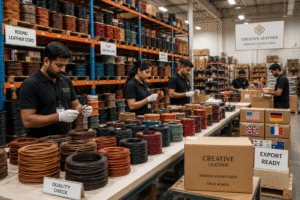
This is where transitioning to a leather cord bulk supplier makes total financial and creative sense. Buying on continuous 25-meter or 50-meter spools drastically drops your per-meter cost, minimizes annoying end scraps, and ensures consistent dye lots across your entire product line. When sourcing wholesale rolls online, always ask suppliers whether their stock is continuously extruded or spliced, and confirm whether the dye is colorfast (meaning it won’t bleed onto your clothes or skin on a hot, sweaty summer day).

Caring for Your Leather Creations

Natural leather is organic, which means it requires a tiny bit of love to stay supple over the years.

  • Keep it dry: While a light splash won’t hurt, avoid swimming, showering, or saunas with your leather jewelry. Extended submersion waterlogs the fibers, causing them to warp, shrink, or weaken as they dry out.

  • Condition occasionally: If your cord starts looking a bit dry or dusty after months of heavy wear, rub a minuscule drop of natural leather conditioner or beeswax into the surface with a soft microfiber cloth. Buff it gently to restore its rich luster.

  • Storage matters: Store your pieces flat or hanging loosely in a cool, dry spot away from direct sunlight. Tightly coiling leather cords into cramped, airtight plastic bags for months can set permanent kinks into the grain and trap humidity.

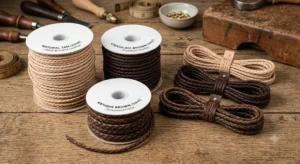
Large spools of black and brown braided leather cord bulk stock

Braided Leather Cord UK

Hands working with braided leather cords in UK workshop
Exploring different profiles and styles of braided leather cords.

The Ultimate Guide to Braided Leather Cord in the UK: Crafting, Sourcing, and Style Trends

Whether you are crafting a rugged men’s wristband, stringing together a bohemian pendant, or pulling together custom handles for a handcrafted tote bag, finding high-quality Leather Cords in UK craft markets is essential for any maker project. There is something deeply satisfying about working with natural, textured materials—it brings a weight, warmth, tactile character, and flexibility that synthetic cords, nylon threads, or cheap plastic imitations simply cannot match.

If you have ever spent an afternoon browsing online craft supply stores or wandering through local UK artisan markets looking for quality Leather Cords in UK for your next big build or jewelry repair, you have probably realized that not all leather is created equal. From wide flat profiles to chunky multi-strand round weaves, getting the right material and thickness can make or break your entire design.

In this comprehensive guide, we are going to dive deep into everything you need to know about working with, choosing, styling, and preserving braided leather. We will also look at how to source top-tier material in the UK without hitting a quality wall or wasting your budget.

What Makes Braided Leather Cord So Special?

Before we look at sizes and crafting techniques, it is worth asking: why choose braided leather over smooth single-strand leather strips or plain round cords?

While a single smooth strand of leather looks clean, structured, and minimal, braided leather introduces a totally different dynamic and aesthetic energy to any project.

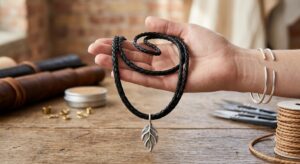
Black woven necklace with leaf pendant drape test on wooden table
Braided leather offers exceptional flexibility and a smooth, natural drape.

1. Superior Flexibility and Natural Drape

leather cord in UK Single-strand thick leather can feel remarkably stiff, especially at higher diameters like 4mm or 6mm. It takes weeks—sometimes months—of continuous wear to break in a solid strip of thick leather. Braids, on the other hand, are inherently supple. By weaving multiple thin, pliable strips of hide around a core, the cord gains immediate flexibility. It drapes naturally around the curves of a neck or wrist from day one without biting into the skin or feeling rigid.

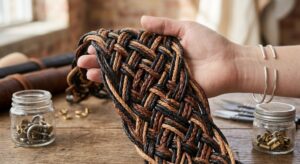
Close up view of multi strand tan and brown interwoven craft material
The interlocked multi-strand weave adds rich visual depth and texture.

2. Rich Dimensional Texture

The interlocked pattern of a woven braid catches light and shadow in a unique way. As you turn a braided piece under natural sunlight, the weave reflects subtly different tones depending on how individual strands were cut and dyed. This creates a visual depth and vintage appeal that plain flat leather simply cannot emulate.

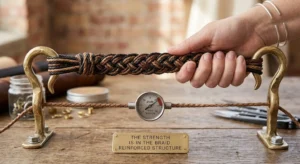
Tension gauge measuring high pull strength on brass testing hooks
Interwoven construction provides high tensile strength under heavy wear.

3. Structural Tensile Strength

Multi-strand weaves distribute tension and physical strain across several interwoven strips rather than relying on a single structural line. In everyday practical terms, this means that even if one outer strand suffers minor surface wear or abrasion over years of heavy use, the overall integrity of your necklace, lanyard, or bracelet remains rock solid.

Understanding Profiles: Flat Leather Cord vs. Round Braids

When planning a build, matching the physical profile of your leather cord to your hardware and intended wear style is crucial. Let’s look at the two dominant profile categories used by leather cord in UK  creators.

Flat Leather Cord: The Classic Cuff and Strap Choice

A Flat Leather Cord is designed with a wide, low-profile footprint that rests comfortably flat against the skin. Because of its structural shape, it does not twist or roll easily when worn around the wrist or waist.

  • Best Applications: Wide wrap bracelets, rustic watch straps, bookbinding ties, bag trim, and belt accents.

  • Key Advantage: Distributes weight evenly across a broader surface area, making it very comfortable for heavier wristwear or utility items.

  • Hardware Pairings: Fold-over crimps, wide magnetic clasps, belt-style buckles, and flat slide charms.

Round Braided Cords: The Versatile Jewelry All-Rounder

Round braided cords are constructed using 3-strand, 4-strand, or 8-strand weaving techniques, often folded tightly around a soft central leather or textile core. This construction creates a symmetrical, cylindrical cord that maintains its shape beautifully.

  • Best Applications: Necklaces, pendant cords, beaded slider bracelets, keychains, and decorative drawstrings.

  • Key Advantage: Symmetrical profile allows beads, bails, and charms to slide smoothly around the cord without catching edge corners.

  • Hardware Pairings: Round glue-in bayonet clasps, magnetic barrel clasps, folded cord caps, and lobster claws with jump rings.


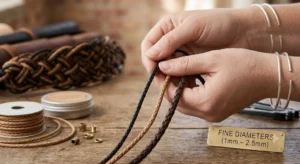
Hands holding thin 1mm 2mm and 2.5mm craft strands side by side
Fine diameter cords are ideal for delicate jewelry and detailed work.


┌───────────────────────┬─────────────────────────────────┬────────────────────────────────────┐
│ Profile Type          │ Ideal Project Applications      │ Best Hardware Attachments          │
├───────────────────────┼─────────────────────────────────┼────────────────────────────────────┤
│ Flat Leather Cord     │ Wide cuffs, watch bands, wrap   │ Fold-over crimp ends, wide slide   │
│                       │ bracelets, bookbinding accents   │ buckles, flat slide-on beads       │
├───────────────────────┼─────────────────────────────────┼────────────────────────────────────┤
│ Fine Round Braids     │ Delicate pendant necklaces,     │ Mini barrel clasps, crimp beads,   │
│ (1.5mm - 3mm)         │ multi-strand woven bracelets    │ wire-wrapped loop ends             │
├───────────────────────┼─────────────────────────────────┼────────────────────────────────────┤
│ Mid Round Braids      │ Classic neck cords, statement   │ Push-and-twist bayonet clasps,     │
│ (4mm - 5mm)           │ unisex wristwear, lanyards      │ magnetic locking end caps          │
├───────────────────────┼─────────────────────────────────┼────────────────────────────────────┤
│ Heavy Round Braids    │ Keychains, bag handles, pet     │ Heavy-duty swivel snap hooks,      │
│ (6mm and above)       │ leashes, heavy outdoor gear     │ oversized screw-in shackle clasps  │
└───────────────────────┴─────────────────────────────────┴────────────────────────────────────┘

Finding the Right Size for Your Creation

Width matters tremendously when choosing high-grade Leather Cords in UK supply channels. Selecting the wrong diameter often means your beads won’t fit, or your necklace ends up feeling awkwardly thick or flimsy.

Comparison of medium 3mm 4mm and 5mm leather cords in UK sizes
Mid-size cords are the sweet spot for daily wear pendant necklaces.

Fine Diameters (1mm – 2.5mm)

Micro cords are subtle and refined. They work brilliantly for delicate multi-wrap bracelets, detailed macramé leather weaving, or stringing gemstone beads with smaller drill holes. While delicate in appearance, high-quality real leather micro braids retain impressive strength.

Coils of genuine vegetable tanned material with small glass storage jars
Genuine hides soften over time, developing a unique natural patina.

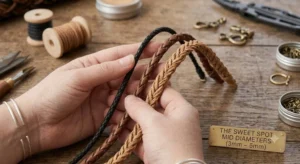
The Sweet Spot: Mid Diameters (3mm – 5mm)

If you are planning to assemble a Leather Cord for Necklace project, the 3mm to 4mm range is almost always the universal sweet spot. Cords in this range are substantial enough to carry heavy silver pendants, brass medals, or natural crystal stones without looking disproportionate, yet slim enough to feel lightweight around the wearer’s neck.

Statement Territory: Leather Cord 6mm and Beyond

When you move up to a Leather Cord 6mm or higher, you enter bold, tactile territory. A Leather Cord 6mm width is ideal for making heavy men’s wristbands, thick lanyard cords, sturdy drawstrings for waxed canvas rucksacks, or custom leather pet leads. Working with 6mm cord requires sturdy hardware, so always double-check the inner millimeter diameter of your end caps before purchase!

Material Authenticity: Spotting the Real Deal

When searching through local craft stores or buying online, navigating product descriptions can get confusing. Understanding leather terminology ensures you don’t waste money on materials that fall apart after a month of wear.

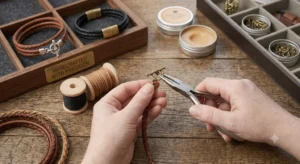
Craftsman using metal pliers to attach vintage toggle clasp to jewelry
Attaching custom metal findings and clasps to braided cords.

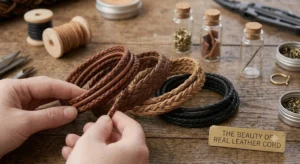
The Beauty of Real Leather Cords in UK

If you want an accessory that ages gracefully over time, insisting on a Real Leather Cord is essential. Real full-grain or top-grain vegetable-tanned leather contains natural fibers that absorb body oils and environmental exposure as you wear it. Over time, a Real Leather Cord softens, darkens slightly, and develops a lustrous natural patina that gives it genuine personality.

The Retail Reality Check: What About Big-Box Brands?

Crafters often search globally for inspiration or supplies, stumbling across listings like Leather Cord walmart or Leather Cord Michaels during their research. While these massive retail platforms cater well to quick weekend school crafts or budget costume builds, much of what is sold under generic craft tags can be synthetic.

Terms like “PU leather,” “bonded leather,” “leatherette,” or “microfiber leather” indicate that the product is made from shredded scrap fibers bound with synthetic plastics or coated with polyurethane. Synthetic options lack tensile memory, tend to peel or crack when exposed to water or sweat, and lack the organic feel of genuine hide. If durability and professional craftsmanship are your goals, stick to full-grain genuine hides sourced from reputable leather crafting specialists.

Color Selection and Styling Strategies

The color of your leather sets the foundation for your design aesthetic. While rich chestnuts, cognac tans, and vintage saddle browns offer rustic, earth-toned charm, one color option stands undisputed in versatility.

Why Leather Cord Black is an Essential Workshop Staple

If you were to stock only one spool of material in your studio, a high-quality Leather Cord Black should always be your first pick.

A sleek Leather Cord Black braid creates high visual contrast against bright metal findings—whether you are working with oxidized sterling silver, polished stainless steel, warm copper, or raw brushed brass. It fits seamlessly into modern minimalist design, dark gothic styling, rugged nautical fashion, and high-end urban streetwear. Furthermore, black dyed leather hides wear, dirt, and oil exceptionally well, keeping pieces looking box-fresh even after months of daily use.

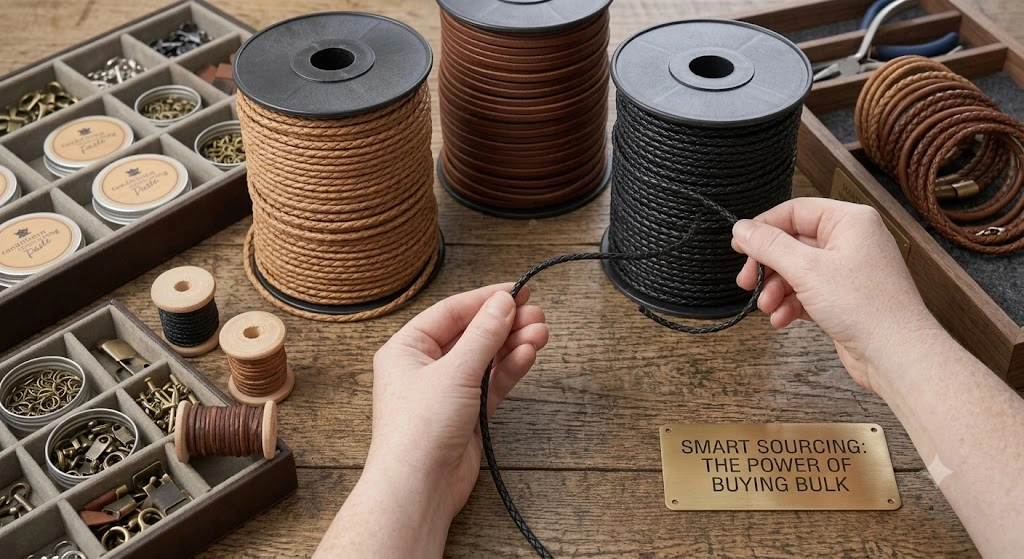
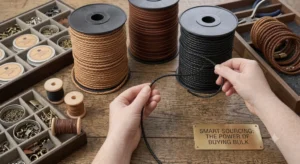
Large spools of black and brown braided leather cord bulk stock
Buying spools in bulk lowers cost per metre and ensures color consistency.

Smart Sourcing: The Power of Buying Bulk

When starting out, most crafters buy short 1-metre pre-cut packs. However, if you plan to craft regularly, sell your creations at UK artisan fairs, or open an online store on platforms like Etsy, buying small retail cuts will quickly eat into your profit margins.

Why Sourcing Leather Cord in UK  Pays Off

Upgrading to a Leather Cord bulk reel—typically sold in continuous spools ranging from 10 metres to 50 metres—offers major advantages:

  1. Massive Cost Savings: Buying in bulk reduces your per-metre cost drastically (often by 40% to 60% compared to short retail cuts).

  2. Color and Dye-Lot Consistency: Leather dyeing is an organic process. Dye lots can vary slightly in tone from batch to batch. Buying a continuous bulk spool ensures that every piece you craft for a specific collection matches identically in tone and surface sheen.

  3. Zero Material Waste: Pre-cut 1-metre strips frequently leave you with useless 20cm scrap ends after cutting a 45cm necklace. Working from a continuous bulk reel allows you to measure and cut exact lengths with zero wasted material.

Step-by-Step DIY Tutorial: Building a Heavy-Duty Pendant Necklace

Ready to put your materials to work? Here is a simple, foolproof guide to crafting a professional-grade unisex pendant necklace using a 4mm round braided leather cord and glue-in metal end hardware.

Tools and Materials Required:

  • 4mm round braided real leather cord (approx. 50cm)

  • 1 x Metal pendant with a bail loop larger than 4.5mm

  • 2 x 4mm glue-in end caps with jump rings

  • 1 x Lobster claw clasp & closing jump ring

  • Professional jewelry adhesive (such as E6000, 2-part epoxy, or flexible instant cyan-acrylate)

  • Sharp rotary leather cutter or heavy shears

  • Measuring tape

1.Measure and Cut Cleanly: Time required: 2 minutes.

Unspool your leather cord in UK and measure out your desired length using a flexible measuring tape. Standard necklace lengths run around 45cm (choker fit), 50cm (standard collarbone drop), or 60cm (low chest drop). Using a very sharp rotary cutter or shears, cut straight across the cord in one firm motion to keep the braid ends clean and unfrayed.

2.Dry-Fit the Core and Caps: Time required: 3 minutes.

Inspect the cut tips of your cord. If the internal core fibers protrude slightly past the outer braided weave, trim them back flush. When working with quality Leather Cords in UK craft setups, test-fit the leather tip inside your metal end cap without glue to ensure it slides in smoothly without bunching up or catching.

3.Thread Your Chosen Pendant: Time required: 1 minute.

Critical Step: Before applying any adhesive to your second end cap, slide your pendant’s bail onto the cord! When crafting custom jewelry using Leather Cords in UK projects, ensuring the pendant is pre-threaded prevents you from having to disassemble your finished hardware later.

4.Glue and Set the Hardware: Time required: 10 minutes cure time.

Apply 2 to 3 small drops of flexible jewelry glue inside the recessed socket of your end cap. Do not overfill, as glue will spill over onto the visible material. Insert the cut tip of your Leather Cords in UK project into the cap while giving it a slight half-turn twist to distribute the glue evenly across the internal walls. Wipe away any excess instantly with a dry cloth. Hold firmly for 30 seconds, then attach your clasp hardware via jump rings once fully cured.


Finished pendant jewelry resting on rustic oak workbench tools
A completed custom braided leather pendant necklace ready to wear.

Essential Care and Maintenance for Braided Leather

Unlike metal chains or synthetic cordage, natural leather is an organic material that absorbs moisture, oils, and environmental factors. To keep your handcrafted braided leather creations looking rich and supple for years to come, share these crucial care tips with your customers or follow them for your personal collection:

Keep Away from Water

Water is the ultimate enemy of dyed natural hides. Never wear your Leather Cords in UK jewelry pieces while swimming, taking a shower, or visiting a sauna. When leather gets saturated with water, the moisture strips away the natural tanning oils inside the hide. As the leather dries out afterward, the fibers contract, making the braid stiff, brittle, and susceptible to cracking along the weave joints.

Apply Conditioner Periodically

Just like a fine pair of leather boots, a braided cord benefits from occasional conditioning. Every few months, place a tiny pea-sized drop of natural beeswax conditioner, neutral leather balm, or mink oil onto a soft microfiber cloth. Gently buff the cloth along the braided weave. This restores moisture, maintains flex, deepens the dye color, and adds a micro-layer of water resistance against sweat.

Store Away from Direct UV Sunlight

Never leave your leather cords or finished jewelry sitting on a sunny windowsill or near direct heat sources like radiators. Prolonged UV exposure breaks down leather dyes rapidly, turning deep blacks into dull grays and fading rich brown hues into washed-out tans. Store your pieces in a cool, dry cloth pouch or a lined jewelry box when not in use.

Comparison of round, flat, and braided leather cords

Leather Cords in Europe | Wholesale Supplier & Manufacturer

If you’re looking for Leather Cords in Europe, you’re in the right place. Whether you’re a jewelry designer, leather craftsman, fashion brand, or wholesale buyer, finding high-quality leather cords is essential for creating products that last.

Across Europe, the demand for premium leather cords has grown significantly. From handcrafted jewelry to luxury accessories and DIY leather projects, these versatile cords have become a preferred choice for professionals and hobbyists alike.

The best part? Europe offers access to some of the finest leather manufacturers and suppliers who provide durable, stylish, and sustainably sourced leather cords for every application.

In this guide, we’ll cover everything you need to know about Leather Cords in Europe, including different types, materials, applications, buying tips, and why choosing a trusted manufacturer can make all the difference.

Hand-braided leather cords in natural, brown, and antique brown colors.
Premium hand-braided leather cords for jewelry making and crafting.

Why Are Leather Cords So Popular in Europe?

Leather has always been associated with durability, elegance, and craftsmanship. Over the years, European designers have embraced leather cords because they offer a perfect balance of strength and style.

Today, Leather Cords are used in various industries, including:

  • Handmade jewelry
  • Fashion accessories
  • Luxury handbags
  • Footwear
  • Decorative crafts
  • Home décor
  • Gift packaging
  • DIY leather projects

Unlike synthetic materials, genuine leather develops a beautiful natural patina over time, making every product unique.

Consumers across Europe also appreciate eco-friendly and sustainable materials, making leather cords an increasingly popular choice for premium products.

What Makes High-Quality Leather Cords Different?

Not all leather cords are made the same. Premium-quality leather cords stand out because of their durability, flexibility, and finish.

When buying Leather Cords in Europe, look for:

  • Genuine leather construction
  • Smooth surface finish
  • Uniform thickness
  • Strong tensile strength
  • Long-lasting color
  • Comfortable flexibility
  • Minimal stretching

High-quality leather cords are easier to work with and enhance the overall appearance of finished products.

Types of Leather Cords Available in Europe

One reason why Leather Cords in Europe are so popular is the wide variety available. Different projects require different cord styles.

Round Leather Cords

Round leather cords are among the most commonly used options. They’re ideal for:

  • Necklaces
  • Bracelets
  • Pendants
  • Decorative accessories
  • Fashion jewelry

Their smooth appearance gives products a clean and professional finish.

Flat Leather Cords

Flat leather cords offer a modern look and are widely used for:

  • Leather bracelets
  • Watch straps
  • Fashion accessories
  • Handmade belts
  • Decorative stitching

They provide excellent surface area for adding charms, beads, or metal findings.

Braided Leather Cords

Braided leather cords combine durability with premium aesthetics.

They’re commonly used for:

  • Premium jewelry
  • Luxury handbags
  • Fashion accessories
  • Home décor
  • Decorative ropes

Their textured design adds elegance and sophistication.

Premium round, flat, and braided genuine leather cords
Luxury genuine leather cords displayed in a professional artisan workshop

Industries That Use Leather Cords in Europe

The market for Leather Cords extends far beyond jewelry.

Some of the biggest industries include:

Jewelry Manufacturing

Designers use leather cords to create:

  • Bracelets
  • Necklaces
  • Anklets
  • Pendants
  • Men’s accessories

Their natural appearance pairs well with metal, wood, and gemstone beads.

Fashion Industry

Leather cords are widely used in:

  • Bags
  • Wallets
  • Jackets
  • Shoes
  • Belts

Fashion brands appreciate their premium appearance and long lifespan.

Handmade Crafts

DIY creators love leather cords because they’re easy to cut, knot, braid, and customize for countless creative projects.

Why Businesses Prefer Wholesale Leather Cords in Europe

Many businesses purchase Wholesale leather cords because buying in bulk offers significant advantages.

Wholesale purchasing provides:

  • Better pricing
  • Consistent quality
  • Large inventory
  • Faster production
  • Reliable supply chain
  • Custom sizes
  • Multiple color options

Whether you’re a retailer or manufacturer, buying wholesale helps reduce production costs while maintaining product quality.

Leather Cords in Europe | Choosing the Right Leather Cord for Your Business

Choosing the right Leather Cords in Europe can make a huge difference in the quality and appearance of your final product. Whether you’re creating handmade jewelry, premium bags, wallets, or fashion accessories, selecting the right leather cord ensures durability, comfort, and style.

With so many options available, it’s important to understand the different materials, finishes, and sizes before making a purchase.

Handmade Leather Cords in Europe

The demand for Handmade leather cords has grown rapidly in recent years. Customers are increasingly looking for products that reflect craftsmanship, authenticity, and uniqueness rather than mass production.

Handmade leather cords are carefully crafted using traditional techniques, resulting in a premium finish and natural texture. Unlike synthetic alternatives, genuine handmade leather develops character over time, making every piece unique.

Many artisans and designers choose handmade leather cords because they offer:

  • Superior craftsmanship
  • Natural leather texture
  • Excellent flexibility
  • Premium appearance
  • Long-lasting durability
  • Comfortable feel

These qualities make them ideal for luxury products and custom-made accessories.

Comparison of round, flat, and braided leather cords
Side-by-side comparison of premium round, flat, and braided leather cords

Best Leather Cords in Europe: What Should You Look For?

Finding the Best leather cords in Europe isn’t just about choosing the most expensive option. Quality depends on several important factors.

Here are the key features to consider before buying:

Genuine Leather

Always choose genuine leather instead of artificial materials. Genuine leather is stronger, ages beautifully, and provides a premium finish.

Smooth Finish

A well-finished leather cord should have a clean surface with minimal imperfections while maintaining its natural look.

Consistent Thickness

Uniform thickness ensures your finished products look professional and remain easy to work with.

Flexibility

High-quality leather cords bend easily without cracking, making them suitable for jewelry and fashion accessories.

Strong Construction

Premium leather cords should resist stretching and maintain their shape even after long-term use.

Different Leather Cord Sizes

One of the biggest advantages of buying Leather Cords in Europe is the variety of sizes available for different applications.

Common thickness options include:

  • 1 mm – Delicate necklaces and earrings
  • 1.5 mm – Bracelets and lightweight accessories
  • 2 mm – Everyday jewelry and DIY crafts
  • 3 mm – Fashion accessories and keychains
  • 4 mm – Bags, belts, and decorative projects
  • 5 mm and above – Heavy-duty leather goods

Choosing the correct size depends on your project and desired appearance.

Popular Colors Available

Modern manufacturers offer Leather Cords in a wide range of attractive colors to match different styles and trends.

Popular choices include:

  • Black
  • Brown
  • Dark Brown
  • Tan
  • Cognac
  • Beige
  • White
  • Grey
  • Navy Blue
  • Green
  • Red
  • Burgundy

Many suppliers also provide custom colors for bulk orders, allowing businesses to create products that align with their brand identity.

Common Applications of Leather Cords

The versatility of Leather Cords makes them suitable for countless industries and creative projects.

Jewelry Making

Leather cords are perfect for:

  • Necklaces
  • Bracelets
  • Anklets
  • Pendants
  • Men’s jewelry
  • Women’s accessories

They pair beautifully with beads, gemstones, wood, and metal charms.

Leather Bags

Many manufacturers use leather cords for:

  • Bag handles
  • Decorative stitching
  • Drawstrings
  • Tassels
  • Shoulder straps

Their durability ensures long-lasting performance while adding a premium touch.

Wallets and Small Leather Goods

Leather cords are commonly used in:

  • Wallet closures
  • Card holders
  • Coin pouches
  • Key organizers
  • Travel accessories

These details enhance both functionality and visual appeal.

DIY Craft Projects

Creative enthusiasts love leather cords for making:

  • Dreamcatchers
  • Keychains
  • Home décor
  • Gift wrapping
  • Plant hangers
  • Decorative wall art

Their flexibility and natural finish make them easy to customize for unique designs.

Workers inspecting premium leather cords in a modern warehouse
Organized warehouse with premium leather cords

Latest Trends in Leather Cords in Europe

Modern buyers prefer products that combine style, quality, and functionality. This shift has influenced the development of Leather Cords in Europe and introduced new designs and finishes to the market.

Here are some of the most popular trends:

Natural and Earth-Tone Colors

Neutral shades continue to dominate the market. Colors such as brown, tan, cognac, beige, black, and olive green remain popular because they complement both modern and traditional designs.

Braided and Textured Finishes

Textured surfaces and braided patterns are becoming increasingly popular in fashion and jewelry. These styles add visual interest and create a premium appearance.

Minimalist Jewelry Designs

Simple leather bracelets, necklaces, and charms are in high demand. Many designers use Leather Cords in Europe to create elegant, minimalist accessories that appeal to both men and women.

Mixed-Material Products

Combining leather with metals, wood, gemstones, and ceramic components has become a leading trend. This approach allows designers to create unique products with a handcrafted feel.

Why Businesses Choose Leather Cords in Europe

Companies across Europe choose high-quality leather cords because they offer a balance of aesthetics and performance.

Here are some reasons businesses prefer Leather Cords in Europe:

  • Long-lasting durability
  • Premium appearance
  • Excellent flexibility
  • Wide range of colors and sizes
  • Compatibility with multiple industries
  • Strong customer appeal
  • Easy customization options

Whether used in fashion, accessories, or crafts, leather cords continue to be a reliable and attractive material.

How to Maintain Leather Cords for Long-Term Use

Proper care can extend the life and appearance of leather products. Following a few simple maintenance tips will help preserve the quality of Leather Cords in Europe.

Keep Them Dry

Although leather is durable, excessive moisture can affect its texture over time. Store leather cords in a dry environment whenever possible.

Clean Gently

Use a soft, dry cloth to remove dust and dirt. Avoid harsh cleaning products that may damage the leather surface.

Store Properly

Keep leather cords away from direct sunlight and extreme temperatures to prevent fading or drying.

Avoid Excessive Stretching

While high-quality leather is flexible, avoiding unnecessary tension will help maintain the cord’s original shape and strength.

How Leather Cords Support Brand Value

Premium materials play an important role in how customers perceive a brand. Businesses that use high-quality Leather Cords in Europe often create products that feel more authentic, durable, and luxurious.

When customers receive well-crafted products, they are more likely to:

  • Trust your brand
  • Make repeat purchases
  • Recommend your products to others
  • Associate your business with quality craftsmanship

This is one reason many successful brands invest in the Best leather cords in Europe for their product lines.

Infographic showing premium leather cord quality features
Premium leather cord infographic highlighting genuine leather

The Growing Demand for Handmade Leather Cords in Europe

The appreciation for handmade products continues to rise. Handmade leather cords in Europe are increasingly sought after because they reflect craftsmanship, attention to detail, and authenticity.

Artisans and boutique brands prefer handmade options because they offer:

  • Unique textures
  • Premium quality
  • Greater attention to detail
  • Distinctive finishes
  • Strong appeal in luxury and handcrafted markets

As consumer preferences shift toward authenticity and sustainable products, the demand for Handmade leather cords in Europe is expected to continue growing.

For businesses seeking reliability, aesthetics, and long-term value, partnering with a trusted supplier of Wholesale leather cords in Europe is an excellent strategy. By focusing on quality, customization, and sustainability, companies can meet customer expectations while building a strong brand presence.

Premium leather cords and jewelry-making workspace.

Leather Cords in USA: Premium Buying Guide

Premium leather cords and jewelry-making tools arranged on a rustic wooden workbench.
Crafted with premium real leather for timeless handmade creations.

Leather Cords in USA are becoming the go-to choice for creators, jewelry makers, and DIY enthusiasts looking for durable, stylish, and high-quality crafting materials. Hey there, fellow creators and DIY enthusiasts! If you have ever spent hours twisting, knotting, or threading a piece of string only to watch it snap, fray, or lose its color after a few weeks, you know the struggle. When you are pouring your heart, soul, and creative energy into a project, the materials you use matter. That is exactly why makers all across the country are upgrading their supplies and hunting for the absolute best Leather Cords in USA markets.

Whether you are looking to design a sleek minimalist necklace, roll out a collection of rugged boho bracelets, or add a rustic trim to a piece of custom furniture, the cord you choose anchors your entire project. But walk down the crafting aisle or browse online for ten minutes, and you will quickly realize that not all leather is created equal. The market is flooded with everything from cheap, synthetic imitations to top-tier, vegetable-tanned straps.

How do you tell the difference? Where should you shop? And how do you pick the right cut, thickness, and style for your specific design? Grab a coffee, get comfortable, and let’s dive deep into the world of premium leather cords in USA sourcing, crafting, and design.

1. Why Premium Leather Cords in USA Beats the Cheap Stuff Every Time

Let’s be real: it is incredibly tempting to grab the cheapest spool of cord you see online just to save a few bucks. We’ve all done it. But when it comes to leather, you truly get what you pay for.

Cheap cords are often made from “bonded leather,” which is essentially the particle board of the textile world. It consists of leftover leather scraps ground up, mixed with plastic glues, and pressed into a strip. When you try to tie a tight knot in bonded cord, it frequently snaps or the colored outer layer peels off right in your hands.

When we talk about premium leather cords in USA crafting circles, we are talking about full-grain or top-grain real leather cords in USA. This material is cut directly from solid animal hides (usually cowhide, buffalo, or goat). It retains the natural, long fiber structures of the skin, giving it incredible tensile strength.

Premium real leather cords in USA  doesn’t just last longer—it actually ages beautifully. Instead of degrading, high-quality leather absorbs the natural oils from your skin over time, developing a rich, soft sheen known as a patina. It feels smooth against the skin, holds its shape without stretching out permanently, and carries that unmistakable, authentic leather aroma. If you are selling your crafts or gifting them to loved ones, using premium materials instantly elevates your work from a simple weekend hobby to a professional, high-end product.

Colorful braided cords on spools with craft tools.
Bright, durable braided cords for creative DIY and jewelry projects. ✨

2. Navigating the Styles: Round, Flat, and Braided Leather Cords in USA

Before you add anything to your shopping cart, you need to understand the different structural styles of leather cord available. Each type behaves differently under tension and yields a completely unique visual aesthetic.

Round Leather Cords in USA

This is the classic, versatile option most people picture when they think of leather string. It features a perfectly smooth, circular cross-section and comes in sizes ranging from a delicate 0.5mm all the way up to a heavy-duty 10mm or more. Round cord is the go-to choice for classic stringing, macramé knotting, wrapping, and beadwork. Because it is smooth all the way around, it slides easily through bead holes and sits comfortably against the skin.

Flat Leather Cord

If you want to make a bold, modern statement, flat leather cord is your best friend. Cut into flat ribbons or straps, this style is fantastic for wide cuff bracelets, wrap bracelets, chokers, and bag handles. Because it lies completely flat against a surface, it is incredibly comfortable for wider jewelry pieces. You can also buy it with stitched edges, printed patterns, or metallic finishes to give your designs an instant fashion-forward edge.

Braided Leather Cord

Braided cord (often referred to as bolo cord) is created by weaving multiple thin strands of leather together around a solid core. This technique results in a highly textured, incredibly strong, and flexible rope. It is the signature material for traditional western bolo ties, but it has exploded in popularity for modern men’s jewelry, luxury keychains, and heavy utility lanyards. The braided texture catches the light beautifully and adds immediate visual depth to even the simplest designs.

Leather cord selection guide with sizes and jewelry uses.
Choose the right leather cord size for every jewelry and craft project.

3. Demystifying Sizes: Matching the Millimeters to the Project

Size matters—especially in the world of leather crafting. Choosing a cord that is too thick means your beads won’t fit; choosing one that is too thin means your heavy pendant will look unbalanced or snap under pressure. Let’s break down the most common sizes you will encounter when searching for leather cords in USA supply shops:

  • 0.5mm to 1.5mm: These ultra-fine cords are designed for intricate work. They are perfect for threading small seed beads, wrapping wire accents, or creating delicate, layered minimalist jewelry.

  • 2mm to 3mm: The absolute sweet spot for everyday jewelry making. A 2mm or 3mm leather cord for necklace designs is strong enough to support heavy silver pendants, pewter charms, or large gemstone beads while remaining flexible enough to tie clean, adjustable knots.

  • 4mm to 5mm: Things are getting sturdier here. These sizes are ideal for chunky men’s bracelets, braided bolo ties, or structural elements in bags and garments.

  • Leather cord 6mm and up: This is heavy-duty territory. A leather cord 6mm or wider is thick, substantial, and highly visible. It is rarely used for standard bead stringing. Instead, it shines as the main body of a chunky statement bracelet, a rugged wallet chain, decorative home decor piping, or durable outdoor gear lanyards. When working with a thick leather cord 6mm option, you will want to look for specialized heavy magnetic clasps or fold-over metal end caps to finish the piece cleanly.

4. The Color Spectrum: Classic Black to Vibrant Metallics  Leather Cords in USA

Color plays a massive role in setting the mood of your design. While natural tones will always hold a special place in leathercraft, modern dyeing techniques mean you can find premium leather in virtually any shade imaginable.

  • Leather Cord Black: You can never go wrong with a classic. A sleek leather cords in USA black strand provides the ultimate high-contrast backdrop for silver, gold, or bright white pearls. It is sophisticated, modern, and universal. It fits just as well in a high-end luxury jewelry boutique as it does in a rugged motorcycle apparel shop.

  • Browns and Tans (Natural, Chocolate, Antique): If you are aiming for an earthy, rustic, or bohemian vibe, natural shades are the way to go. Distressed or “antique” finishes are particularly cool because they features subtle color variations along the cord, giving your project an instant, lived-in vintage character.

  • Brights and Metallics: Want to shake things up? Premium cords are available in stunning turquoise, deep reds, royal blues, and even shimmering golds and silvers. High-quality dyed cords are thoroughly sealed so that the color won’t bleed onto your skin or clothes when exposed to sweat or a sudden rain shower.

Brown flat leather cord coil.
Smooth flat leather cord for premium handmade accessories.

5. Where to Buy: Giant Retailers vs. Specialty Bulk Suppliers

When you are ready to restock your workbench with leather cords in USA regions, you have a few distinct paths to choose from depending on your timeline, budget, and project scale.

The Big-Box Craft Stores: Michaels and Walmart

We have all been there: it is Sunday afternoon, you are in the middle of a project, and you suddenly run out of string. Heading over to get a leather cord Michaels spool or checking the craft aisle for a leather cord walmart pack is incredibly convenient for quick fixes, small school projects, or prototyping a brand-new idea.

These retail options are accessible, affordable, and perfect for beginners who want to test the waters before investing heavily. However, if you are looking for highly specific sizes, premium vegetable-tanned full-grain hides, or unique custom colors, the selection at big-box retailers can sometimes be limited.

Specialized Wholesale and Bulk Suppliers

If you are running a small business, crafting for an upcoming holiday market, or simply obsessed with getting the absolute highest grade of material, you want to bypass the retail aisles and look into ordering leather cord bulk quantities from specialized distributors.

U.S.-based specialty suppliers source elite hides, use safe, eco-compliant dyes, and offer massive spools at wholesale prices. Buying leather cord bulk styles dramatically drops your cost-per-foot, ensuring your hobby stays affordable or your business margins stay healthy. Plus, specialty shops carry the heavy-duty varieties—like that specialized leather cord 6mm thickness—alongside matching professional hardware like magnetic clasps and crimp ends that you won’t always find at standard retail stores.

6. Pro Tips for Working with Premium Leather Cord

Once you have your premium  leather cord in USA on your workbench, follow these essential tips to ensure a smooth crafting process and a flawless finished product:

  1. Straighten Your Cord Seamlessly: Leather cord arrives wound tightly around a spool, meaning it will have some natural kinks and curls when you first unroll it. Don’t panic! Simply run the cord through a damp cloth a few times, then hang it up with a small weight at the bottom for an hour. The residual moisture and gentle gravity will pull it perfectly straight without damaging the hide.

  2. Cut at an Angle: When you are prepping your cord to slide through a bead or an end cap, never cut it completely flush or straight across. Use a pair of sharp shears to cut the tip at a sharp 45-degree angle. This creates a pointed “needle” effect that makes threading infinitely easier.

  3. Choose the Right Adhesive: If you are gluing your leather into metal end caps or clasps, step away from the standard superglue. Standard superglues dry into a brittle, glass-like state that can easily crack and fail when the flexible leather bends. Instead, opt for a flexible, heavy-duty jewelry glue or a premium two-part epoxy. These adhesives remain slightly rubbery when cured, moving with the leather and ensuring a permanent bond.

  4. Condition for Longevity: Just like a premium pair of leather boots or a high-end jacket, your leather jewelry and crafts appreciate a little love. If your pieces are exposed to the elements This keeps the fibers hydrated, supple, and completely crack-free for years to come.

    Premium leather cords and jewelry-making workspace.
    Quality leather cords crafted for unique handmade jewelry and accessories.

Summary Checklist for Your Next Leather Project

To make your next shopping trip or online order completely stress-free, use this quick reference breakdown to match your creative vision with the perfect materials:

Project Type Recommended Cord Style Ideal Thickness Best Sourcing Option
Delicate Bead Strung Jewelry Round Real Leather Cord 1.0mm – 1.5mm Retailers (Michaels / Walmart)
Standard Pendant Necklaces Round Leather Cord for Necklace 2.0mm – 3.0mm Retail / Specialty Stores
Boho Wrap Cuff Bracelets Flat Leather Cord or Suede 3.0mm – 5.0mm width Specialty / Bulk Suppliers
Rugged Men’s Jewelry & Bolos Braided Bolo / Heavy Round Cord 4.0mm – 5.0mm Wholesale Bulk Suppliers
Statement Pieces & Utility Gear Heavy Round Leather Cord Black 6.0mm+ Bulk Specialty Distributors

Ultimate Guide to Buying Leather Cords in USA Online.

Uniform, center-cut strand ensures consistent thickness.
Look for a smooth finish, dense hide for high tensile strength, and a continuous strand free of factory splices.

Leather Cords in USA stores online can feel like an absolute wild goose chase. One minute you think you found a steal, and the next, your custom jewelry project is snapping in half because the material was dry-rotted or made of flimsy scraps.

Whether you are rolling out a brand-new line of artisan jewelry, braiding a rugged bolo tie, wrapping handles for historical cosplays, or just messing around with DIY gifts, you need the good stuff.

Welcome to your definitive, zero-nonsense roadmap. We are skipping the textbook lectures and diving straight into the practical world of buying Leather Cords in USA digital shops. We will cover the specific terms to search for, the absolute best places to buy, how to spot fakes, and how to get exactly what you need without overpaying.

1. Decoding the Types: More Than Just a String

Before you click “Add to Cart,” you need to know exactly what kind of material matches your specific vision. Leather isn’t just leather—it comes cut, processed, and treated in completely different ways depending on what it’s built for. Let’s break down the main styles you will encounter online.

Round Leather Cord

This is the absolute king of the jewelry world. If you look at a classic pendant hanging from a simple, clean strand, you are looking at round cording. It is sliced precision-clean from the center of a hide to keep its thickness totally uniform.

  • Best For: Minimalist jewelry, heavy pendants, and intricate macramé braiding.

  • Pro Tip: Look for “precision-cut” or “cured center-cut” to avoid thin spots that snap under tension.

Flat Leather Cord in USA

When you want a modern, sleek, or distinctly Western look, Flat Leather Cord is your go-to. It gives you a wider surface area, making it perfect for stamped designs, wide wrap bracelets, or custom watch bands.

  • Best For: Multi-wrap cuffs, chokers, boho styles, and lining the edges of larger leather goods.

  • Pro Tip: Check the edge finishing. Premium flat varieties will have burnished or painted edges so they don’t scratch your skin.

Braided and Bolo Leather

Think cowboy cool meets high-end texture. Braided options usually feature several thin strands woven tightly around a solid inner core. This core keeps the cord from stretching out or warping over time.

  • Best For: Bolo ties, rugged men’s bracelets, and heavy-duty lanyards.

2. Real vs. Faux: The Truth About Materials

The online marketplace is absolutely flooded with listings. If you aren’t careful, you might end up buying plastic masquerading as animal hide. Here is how to parse the product descriptions like an expert.

Real Leather Cord

If a listing proudly states it is Real Leather Cords in USA, you want to look closely at the source animal.

  • Cowhide: The golden standard for strength. It is dense, handles moisture relatively well, and breaks in beautifully.

  • Deerskin/Goatskin: Incredibly soft and supple right out of the package. It is perfect for clothing fringe or delicate lacing, but it will stretch if you pull it too hard.

Faux, Suede, and Microsuede

If you see terms like “PU,” “faux,” “vegan,” or “microsuede,” you are dealing with synthetic options or highly processed split hides. While they are incredibly uniform in color and very affordable, they lack the tensile strength, natural smell, and aging properties of the genuine article. They are great for budget practice, but not ideal for heirloom-quality pieces.

3. The Big Size Guide: Millimeters Matter

Size errors are the number one reason online buyers return their crafting supplies. A single millimeter doesn’t sound like much until your beads won’t slide onto the strand. Use this quick reference chart to match your project to the right thickness.

A collection of various premium genuine leather cords arranged on a rustic wooden workbench, featuring multiple wooden spools of round cord in different sizes (1mm, 1.5mm, 2mm), coils of flat black leather, a loop of thick 6mm brown cord, and a braided leather strand being measured precisely at 3.0mm with a digital caliper.
A professional crafting setup displaying different styles, shapes, and precise millimeter sizes of premium genuine leather cords.
Size (Thickness) Best Used For Common Projects
0.5mm – 1.0mm Ultra-fine beadwork, delicate knots Micro-macramé, seed bead stringing
1.5mm – 2.0mm The classic Leather Cord for Necklace look Pendant drops, delicate wrap bracelets
3.0mm – 4.0mm Medium-duty statement pieces, wraps Men’s jewelry, heavy metal charms, lacing
5.0mm – 6.0mm Heavy statement pieces, utility ropes Leather Cord 6mm cuffs, dog leashes, bolos

4. Where to Buy Leather Cords in USA Online

Where you buy depends entirely on your project’s scale, your timeline, and your budget. Let’s evaluate your options honestly.

The Retail Giants: Quick & Accessible

Leather Cord Walmart

  • The Vibe: Ultimate convenience and rock-bottom pricing.

  • The Reality: If you search for Leather Cord walmart, you will find plenty of affordable spools, especially from third-party marketplace sellers. It is perfect if you need basic colors like a classic Leather Cord Black or dark brown for a weekend project. However, double-check the descriptions carefully to ensure you are buying genuine cowhide rather than faux suede blends.

Leather Cord Michaels & Hobby Lobby

  • The Vibe: The reliable brick-and-mortar craft havens.

  • The Reality: Checking out Leather Cord Michaels online or browsing Hobby Lobby’s digital aisles is great for intermediate crafters. You can buy pre-cut packs or 5-to-25-yard spools easily. The quality is highly consistent, though their specialty color palettes and bulk discounts are somewhat limited compared to dedicated leather houses.

Specialty & Wholesale Houses: For Pros and Addicts

If you are stepping up your game or running a small business, you want to bypass the retail craft aisles and order your Leather Cord bulk supplies directly from wholesale houses or dedicated jewelry supply companies:

  • Leather Cord USA: The absolute benchmark for trade quality. They supply precision-cut round, flat, and braided options in hundreds of custom dyes, metallics, and distressed finishes.

  • Artbeads & Fire Mountain Gems: Excellent online havens if you need high-grade jewelry components, clasps, and specialty cords shipped quickly across the United States.

  • Tandy Leather: The historic destination for heavy-duty, traditional crafting. If you need raw cowhide lace, thick latigo strands, or tools to finish your edges, this is your spot.

A close-up, top-down view of five wooden spools wound with various sizes of round leather cord (2mm, 1.5mm, 2.5mm, 4mm). The spools are labeled 'PREMIUM COWHIDE CORD
A curated collection of premium cowhide cords, ranging from fine round strands to thick braided bolo, displayed with precision measuring calipers on an artisan’s workbench.

5. Step-by-Step: The Foolproof Online Ordering Process

To ensure your online shopping experience is smooth and successful, follow this simple ordering sequence:

1.Check Your Bead Hole Sizes:Prerequisite.

Use a digital caliper or check your bead invoices. If your bead holes are exactly 2mm wide, you need a 1.5mm strand to account for natural variations in the hide.

2.Select Your Material and Shape:Design Phase.

Decide if your project requires the flexibility of round cowhide, the bold surface area of flat lace, or the softness of deerskin.

3.Calculate the Total Yardage:Quantity Phase.

Account for knotting wastage. A standard 18-inch necklace with knotted endings often uses closer to 22 inches of raw cord. If making multi-wrap bracelets, always buy in bulk spools rather than pre-cut packs.

4.Match Your Hardware and Findings:Final Check.

Ensure your spring tips, fold-over cord ends, or magnetic clasps match the exact millimeter thickness of your selected strand.

6. Pro Tips to Avoid Getting Scammed Online

Before you hit the final checkout button, take a quick breath and look for these vital green flags:

The Smell Test (Digitally Speaking): If a seller refuses to mention the word “genuine,” “cowhide,” or “full-grain,” and instead relies heavily on phrases like “leather-like feel” or “premium synthetic material,” they are selling plastic.

  • Look for Dye Stability Ratings: Real dyed hides can occasionally bleed onto skin or clothing when wet. Check user reviews to ensure the vendor uses colorfast, non-toxic chemical treatments.

  • Check the Continuous Length Rule: When buying massive spools of Leather Cord bulk styles, look at the seller’s fine print. High-quality manufacturers state whether a 50-meter spool is one continuous strand or contains factory splices. For long braiding projects, splices are a nightmare!

Leather Cords in UK | Quality Leather Cord.

A wooden workbench showcasing various types of leather cords including flat, round, black, and braided bolo styles, labeled on a rustic craft table with tools.
A showcase of the different types of high-quality leather cords used for jewelry making and crafting.

Hey there, fellow makers, crafters, and jewelry designers! If you’ve ever sat down at your workbench with a killer idea for a rustic wrap bracelet or a sleek minimalist pendant, you know that the backbone of your project isn’t just the shiny hardware—it’s what holds it all together. That’s where Leather Cords in UK come in. Whether you’re creating handcrafted jewelry, fashion accessories, or DIY craft projects, choosing high-quality leather cords ensures your designs are durable, stylish, and built to last. From natural leather finishes to a variety of colors and thicknesses, the right leather cord can transform a simple idea into a professional-quality creation.

Today, we’re diving deep into the world of Leather Cords in UK crafting circles. Whether you are a casual hobbyist trying to whip up a birthday gift or an established artisan looking to stock up on premium supplies, choosing the right stringing material is a complete game-changer.

Grab a cuppa, pull up a chair, and let’s talk about why quality leather matters, how to avoid the cheap plastic-y traps, and how to source the absolute best materials for your next masterpiece.

Why Quality Real Leather Cord Beats the Alternatives Every Single Time

Let’s address the elephant in the studio first: why should you spend your hard-earned cash on a premium, Real Leather Cord in UK  when there are countless faux alternatives filling up your social media feeds?

It all comes down to tactile feel, structural integrity, and how the piece ages. Faux leather—often listed as PU or pleather—is essentially plastic bonded to a fabric backing. When you work with it, it feels stiff, it has a weird chemical smell, and worst of all, it degrades rapidly. Within a few months of daily wear, a faux leather necklace will start to crack, peel, and flake, leaving your beautiful handmade pendants hanging on a frayed mess.

On the flips side, high-quality authentic leather offers:

Close-up of a premium leather cord demonstrating high tensile strength with a detailed view of its natural collagen fiber structure.
Premium leather cords offer exceptional tensile strength, flexibility, and long-lasting durability for jewelry and leathercraft projects.
  • Tensile Strength: Real animal hide contains microscopic, interlocking collagen fibers. This natural matrix gives it incredible strength under tension, meaning it won’t snap unexpectedly when someone catches their bracelet on a door handle.

  • The Graceful Ageing Process (Patina): High-grade leather absorbs the natural oils from your skin. Over time, a raw or aniline-dyed cord softens up, darkens slightly, and develops a beautiful, rich sheen known as a patina. It literally gets better the more you wear it.

  • Skin Comfort: Because it’s a natural material, authentic leather breathes. It doesn’t cause that sweaty, sticky irritation that synthetic cords do when the British summer actually decides to show up.

When searching for the right materials, you’ll want to focus on sourcing genuine Leather Cords in UK shops that specify the tanning process. Vegetable-tanned options are particularly fantastic for jewelry because they use natural plant tannins rather than harsh chemicals, making them incredibly gentle on sensitive skin.

Exploring Profiles: From Flat Leather Cord to Round Classics

Not all cords are cut the same way, and matching the right profile to your specific design is half the battle. Let’s break down the main styles you’ll encounter when browsing your local or online suppliers.

1. Round Leather Cord

This is the absolute classic. It’s perfectly cylindrical, incredibly versatile, and comes in everything from a hairline 1mm thickness up to a chunky 10mm structural cord.

Premium leather cords on a craft workbench featuring bulk spools, flat leather strips, braided bolo cords, black cords, and finished necklaces with tools.
A professional display of premium crafting leather cords, available in bulk spools, flat lengths, and custom braided designs for high-end jewelry making.
  • Best For: Everyday jewelry, knotting projects, and carrying heavy focal pieces.

  • Pro-Tip: If you are building a timeless piece, a sleek Leather Cord for Necklace designs usually relies on a 1.5mm to 3mm round profile. It sits comfortably against the collarbone and slides effortlessly through standard pendant bails.

2. Flat Leather Cord

If you want to make a bold, contemporary statement, Flat Leather Cord is your best friend. Cut into clean, rectangular strips, it offers a wider surface area that showcases the grain of the hide beautifully.

  • Best For: Men’s cuff bracelets, bohemian wrap designs, stamping metallic accents, and structural leather trim on bags or garments.

  • Design Idea: Try layering three or four parallel strands of 3mm flat cord inside a wide magnetic clasp for an instant, effortless urban-style bracelet.

3. Braided Bolo Cord

Created by tightly weaving multiple thin strands of leather together, braided cord offers a rich, tactile texture. It feels instantly premium and rugged.

  • Best For: Traditional Western bolo ties, high-end bracelets, and heavy-duty lacing.

Getting the Dimensions Right: Sizing for Success

Size matters immensely in leathercraft. Pick something too thin, and your heavy gemstone pendant will look completely disproportionate. Pick something too thick, and you won’t be able to thread your beads or tie a secure knot.

A side-by-side comparison of four leather cord sizes (1mm to 6mm+) with matching labels and clasps on a wooden workbench.
A quick visual guide comparing leather cord diameters and recommended hardware.


Diameter / Width Ideal Project Matches Recommended Clasp Types
1mm – 1.5mm Delicate bead threading, intricate macramé, lightweight minimalist charms. Small fold-over crimps or simple sliding knots.
2mm – 3mm The gold standard for a classic Leather Cord for Necklace build or multi-wrap bracelets. 2mm/3mm internal diameter glue-in barrel clasps.
4mm – 5mm Heavy-duty pendants, chunky men’s jewelry, structural lacing on bags. Screw-together caps or heavy spring clasps.
6mm+ Bold statement cuffs, statement necklaces, or handle accents. Wide magnetic locks or custom hook clasps.

If you are working on a piece that needs to balance rugged durability with a distinct, eye-catching presence, a Leather Cord 6mm option is an absolute dream. It’s thick enough to serve as the standalone focal point of a bracelet, requiring nothing more than a premium clasp to look complete.

The Big Sourcing Debate: UK Specialists vs. Big-Box Retail Imports

When you’re ready to buy, it’s incredibly tempting to just type “leather string” into a massive global marketplace or look across the pond for options like Leather Cord walmart or Leather Cord Michaels. While those US big-box retailers are absolute institutions for crafters over there, trying to import small quantities to the UK often leads to a headache of shipping delays, custom fees, and generic quality.

Instead, sourcing your Leather Cords in UK specialty shops offers massive advantages that directly impact your final product:

Consistent Gauge and True Roundness

Cheap, mass-manufactured cord often suffers from terrible quality control. You might buy a spool labeled “2mm,” only to find it tapers down to 1.5mm or balloons up to 2.5mm halfway through the roll. Local UK specialists curate their stock rigorously, ensuring that if you buy a spool of Leather Cord Black in 2mm, it stays exactly 2mm from the first inch to the very last.

Eco-Conscious Tanning Regulations

The UK and EU enforce incredibly strict environmental laws regarding chemical processing. When you buy premium local stock, you can rest easy knowing your cord hasn’t been drenched in restricted heavy metals or toxic azo dyes that could leach onto your skin when you sweat.

Buying Smart with Bulk Options

If you are running a small business or running craft workshops, buying by the meter will quickly eat into your margins. Look for suppliers offering Leather Cord bulk options or full wholesale spools (typically 25m to 100m). Buying in bulk drastically lowers your cost-per-meter and ensures total color consistency across your entire production run.

Designing and Finishing Your Leather Jewelry Like a Professional

The difference between a piece of jewelry that looks “homemade” and one that looks “handcrafted by a professional” lies entirely in the finishing details. Leather requires a slightly different approach than nylon or wire.

1. Mastering the Glue-In End Cap

For round cords like a thick Leather Cord 6mm, trying to tie a knot or use a flimsy crimp bead looks messy. Instead, use professional metal end caps.

  • The Technique: Trim the end of your leather cleanly with a sharp utility knife at a perfect 90-degree angle. Add a single drop of specialized jewelry glue (like hypo-cement or a premium polyurethane-based adhesive) inside the cap. Push the leather in and give it a slight twist to spread the glue evenly. Let it cure completely for 24 hours before wearing.

2. The Classic Sliding Knot

If you want an adjustable, metal-free finish for an organic, beachy look, the double sliding knot (often called a fisherman’s knot) is your go-to technique. It works beautifully on a standard Leather Cord for Necklace layout, allowing the wearer to easily adjust the length from a tight choker to a low-hanging piece.

3. Playing with Contrast

Don’t be afraid to mix your styles! Combining a stark, polished Leather Cord in UKwith bright sterling silver hardware creates an incredible, high-contrast modern aesthetic. If you’re going for a vintage or rugged look, pair distressed brown flat leather with antiqued brass components.

Premium leather cords in various colors and styles for jewelry making and DIY crafts.
High-quality leather cords for necklaces, bracelets, and creative projects.

Keeping Your Leather Creations Beautiful for Years

True Real Leather Cord is an investment, and like any fine leather good, it appreciates a little bit of care. Pass these tips along to your customers or keep them in mind for your personal collection:

  • Keep it Dry: While a little splash of rain won’t ruin it, never wear your leather jewelry in the shower, pool, or sea. Prolonged water exposure strips the natural oils out of the hide, causing it to become brittle and stiff as it dries.

  • Avoid Chemicals: Put your jewelry on after you’ve applied cologne, perfume, hairspray, or lotion. The alcohol and synthetic chemicals in these products can break down the surface dyes on a beautiful Leather Cord Black and cause spotting.

  • Let it Breathe: Don’t store your leather pieces in airtight plastic bags for years on end. Leather needs a tiny bit of ambient humidity to stay supple. A soft fabric pouch or a lined jewelry box is perfect.

Final Thoughts: Fuel Your Creativity

At the end of the day, every incredible design deserves a foundation that lasts. By choosing premium Leather Cords in UK specialist shops, you’re not just buying stringing material—you’re ensuring that the love, time, and creativity you pour into your handmade pieces will look stunning for years to come.

Whether you’re wrapping a wrist in a sleek Flat Leather Cord or suspending a precious heirloom from a delicate strand of Real Leather Cord, enjoy the process, embrace the unique variations of the natural hide, and happy crafting!

What are you working on next? Are you Team Round or Team Flat? Let us know in the comments below, or drop your favorite finishing tips!

X
Add to cart